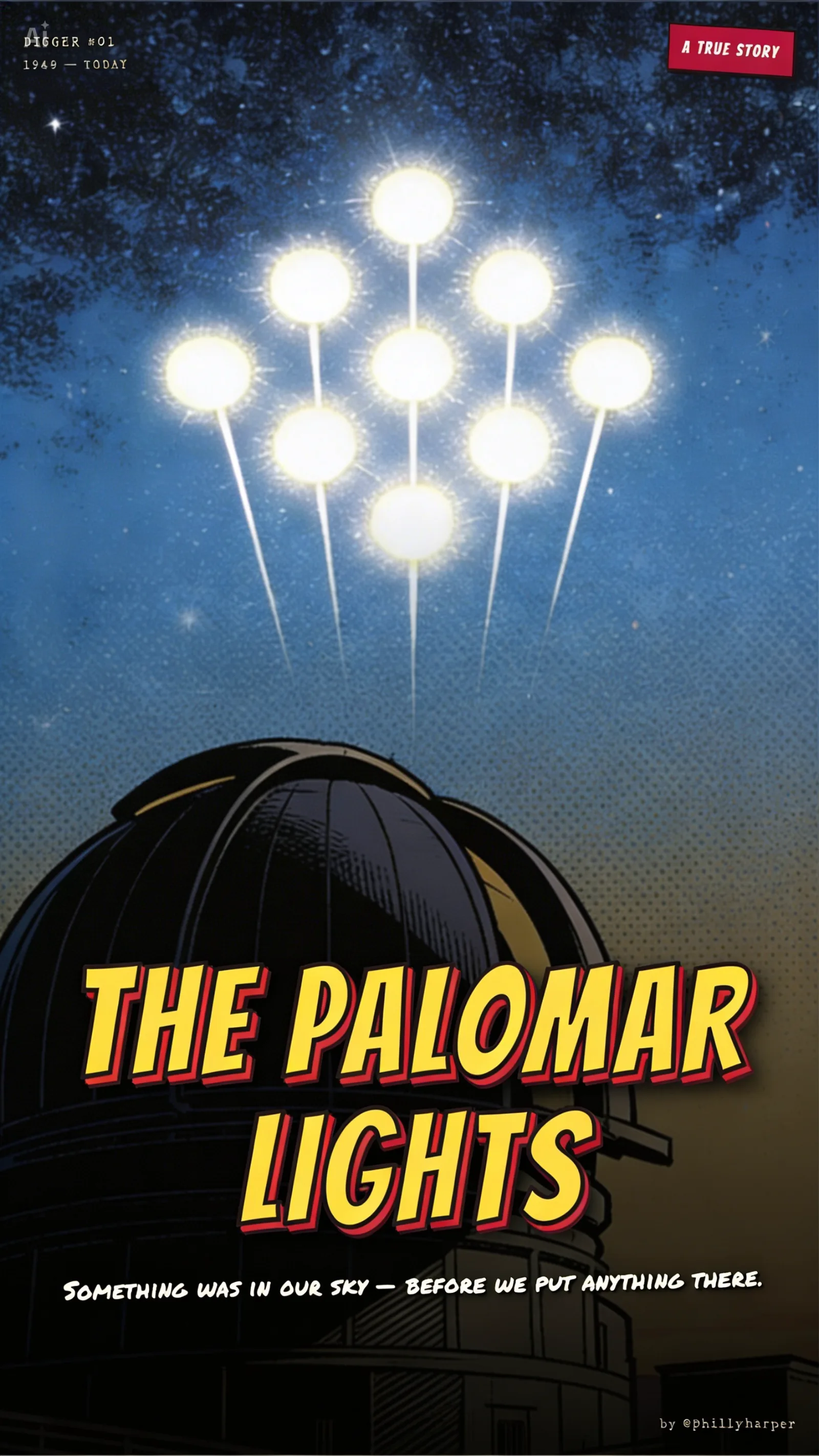
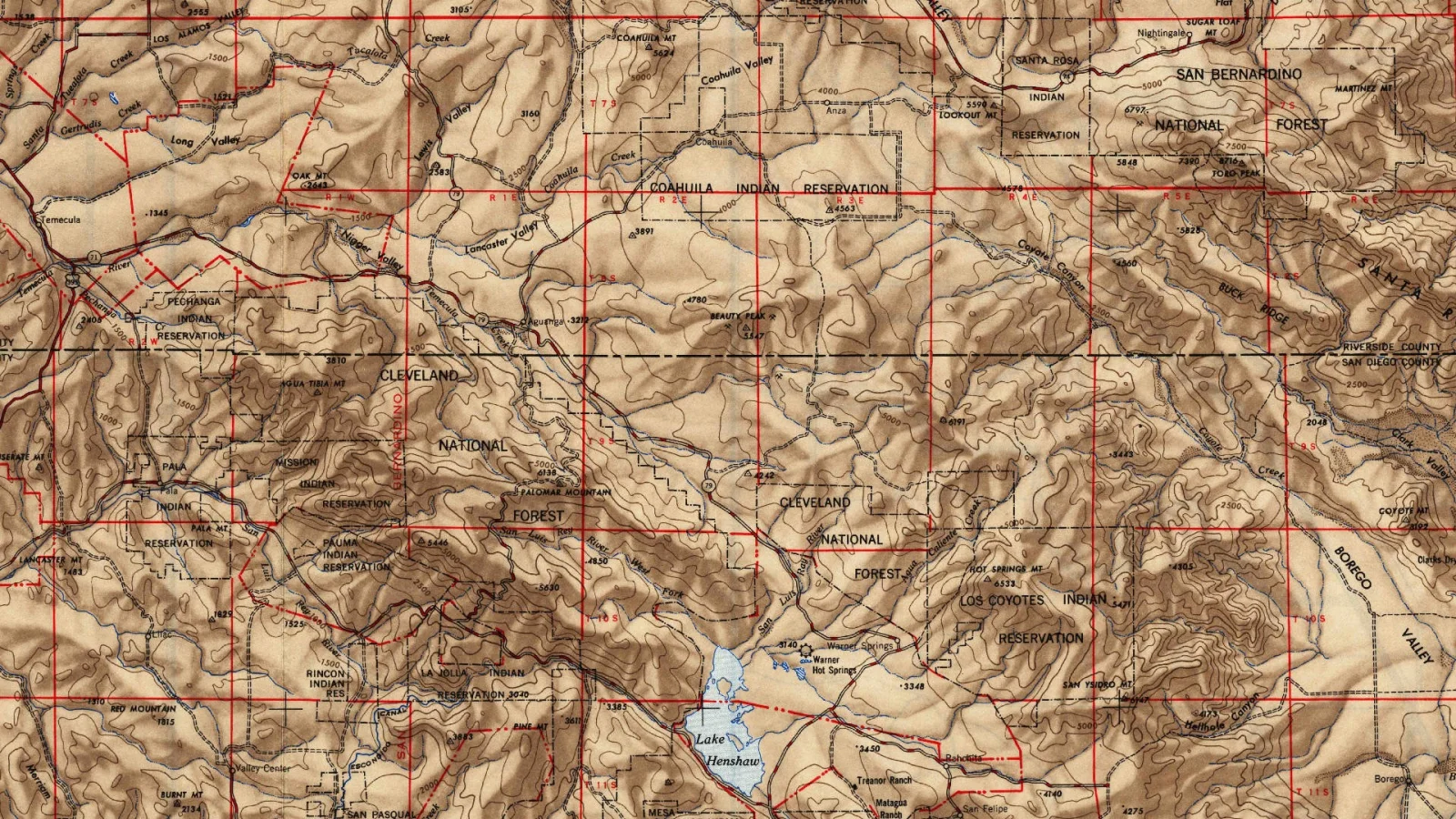
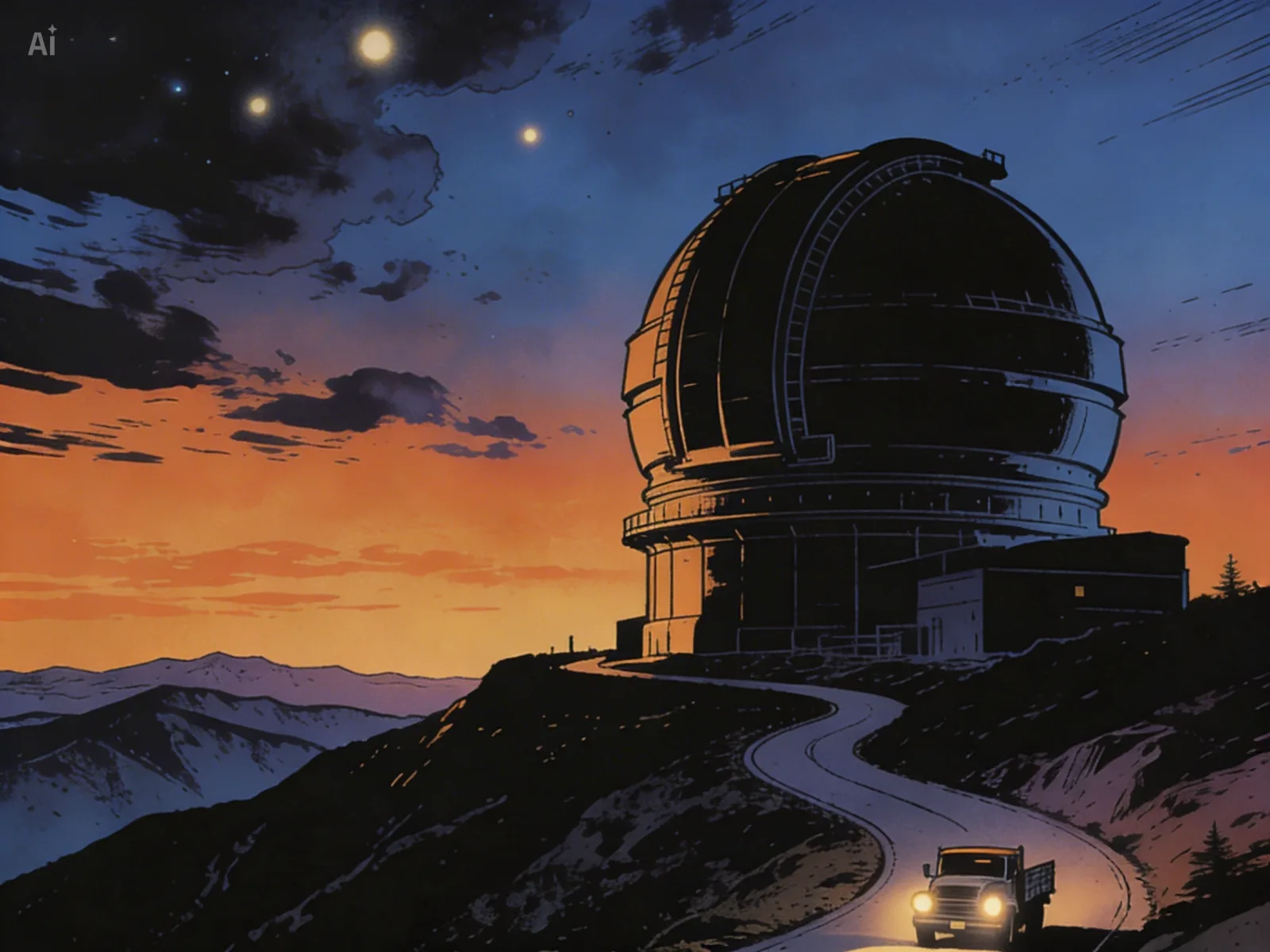
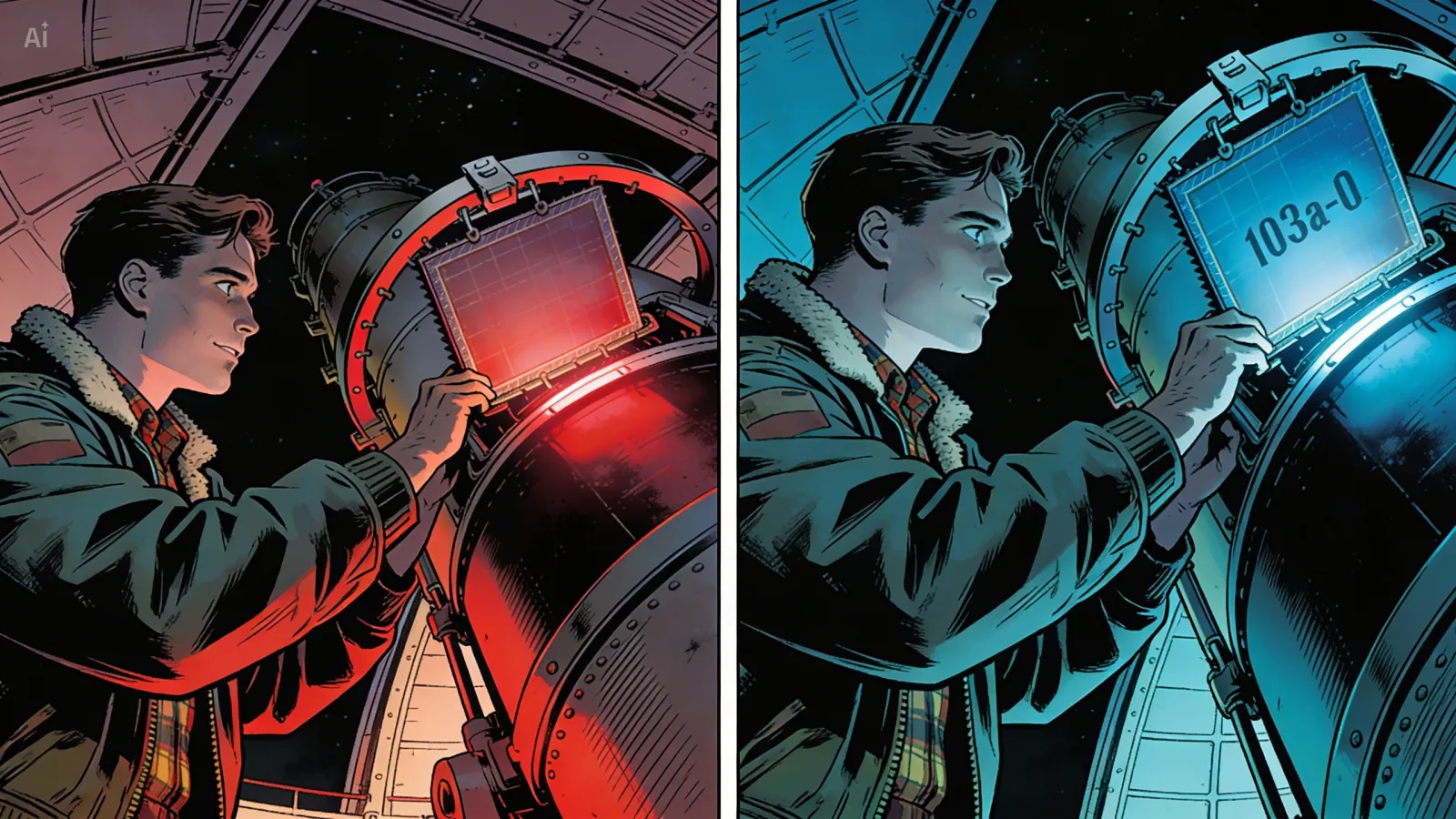
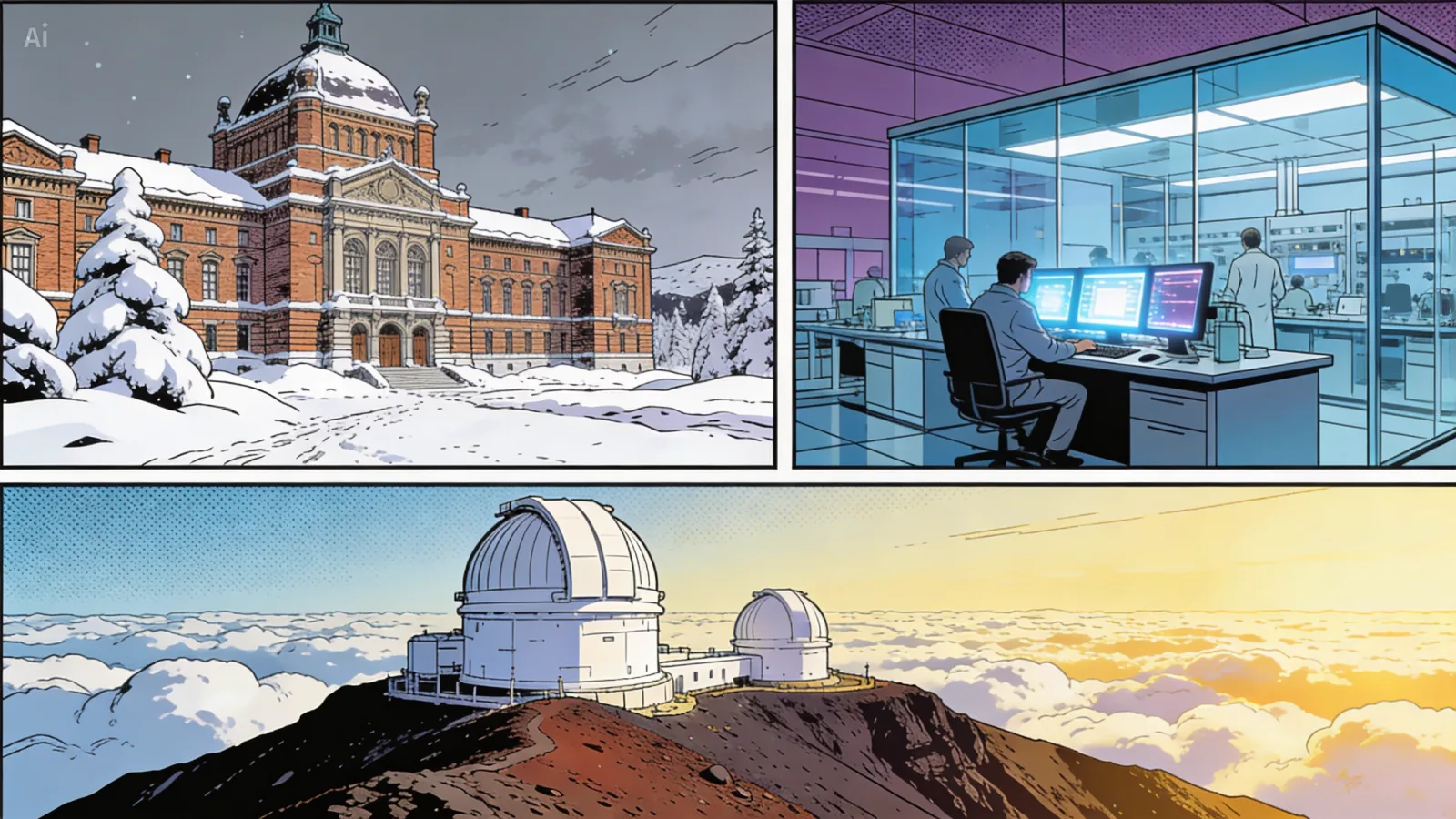
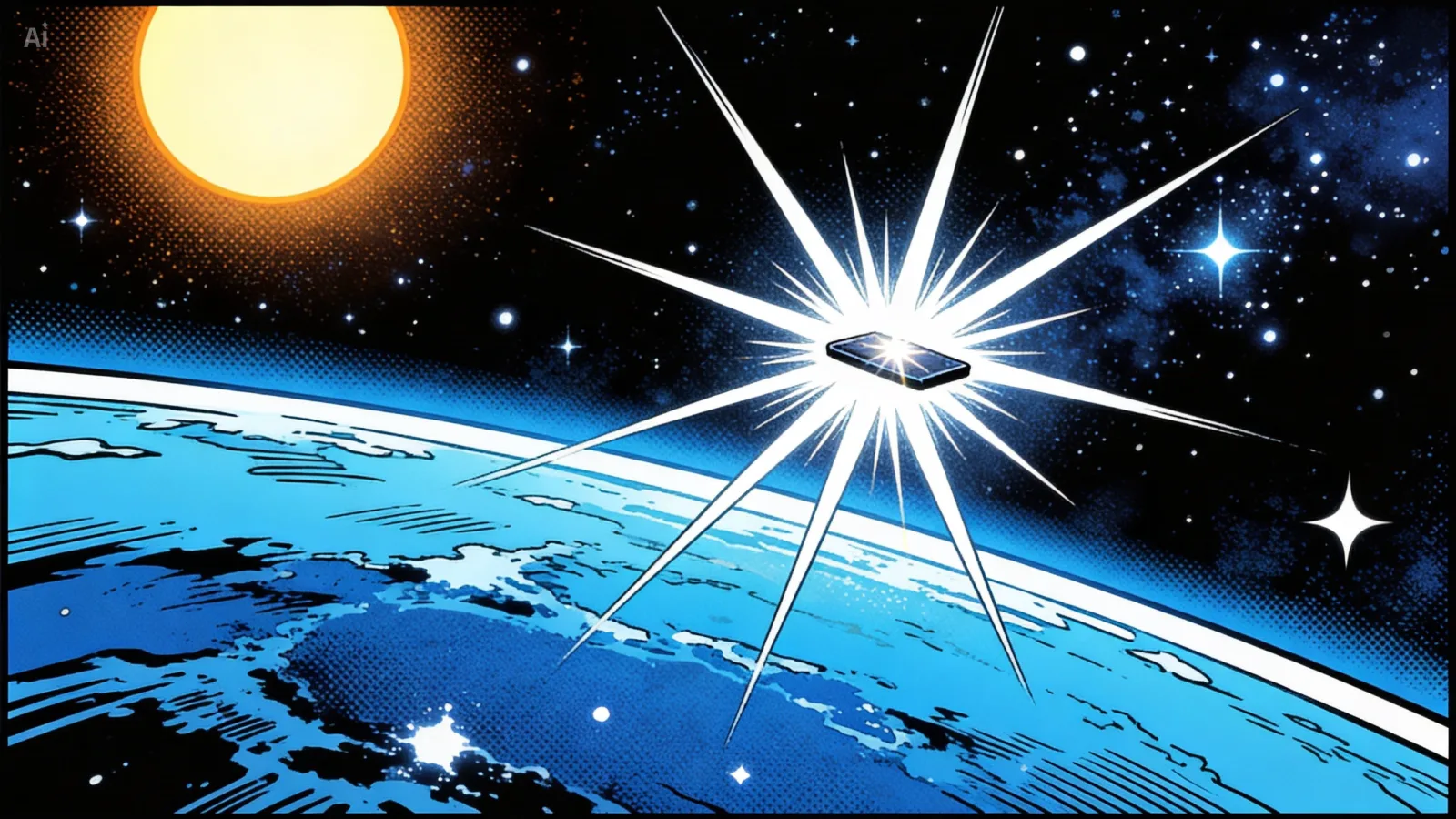
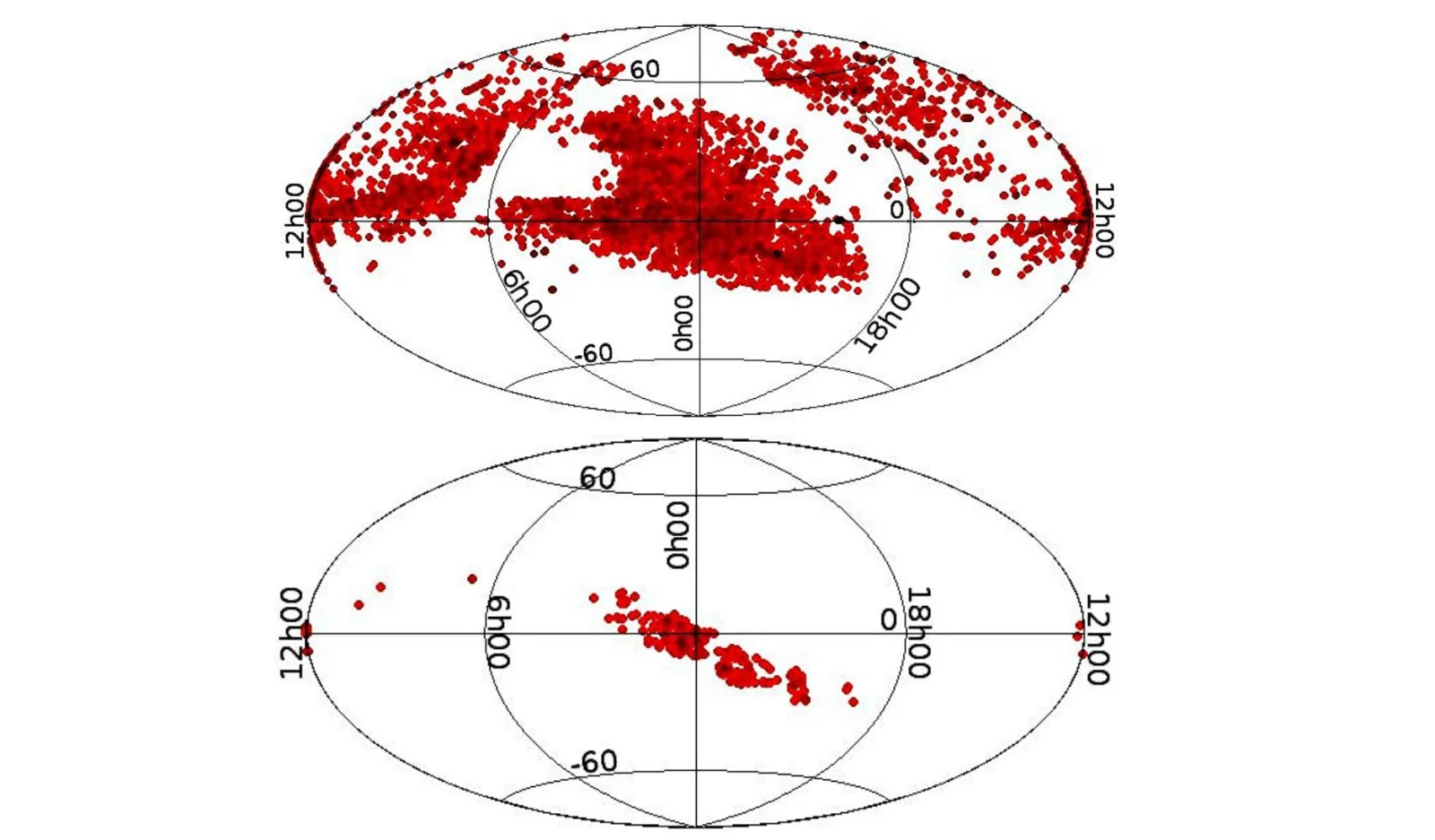
San Diego County, California. Five thousand five hundred feet up, on a forested ridge in the Cleveland National Forest, sits the new 200-inch Hale telescope — the largest ever built. U.S. Geological Survey, Santa Ana sheet, 1:250,000 — surveyed 1949.
Palomar Mountain, California. November 1949.
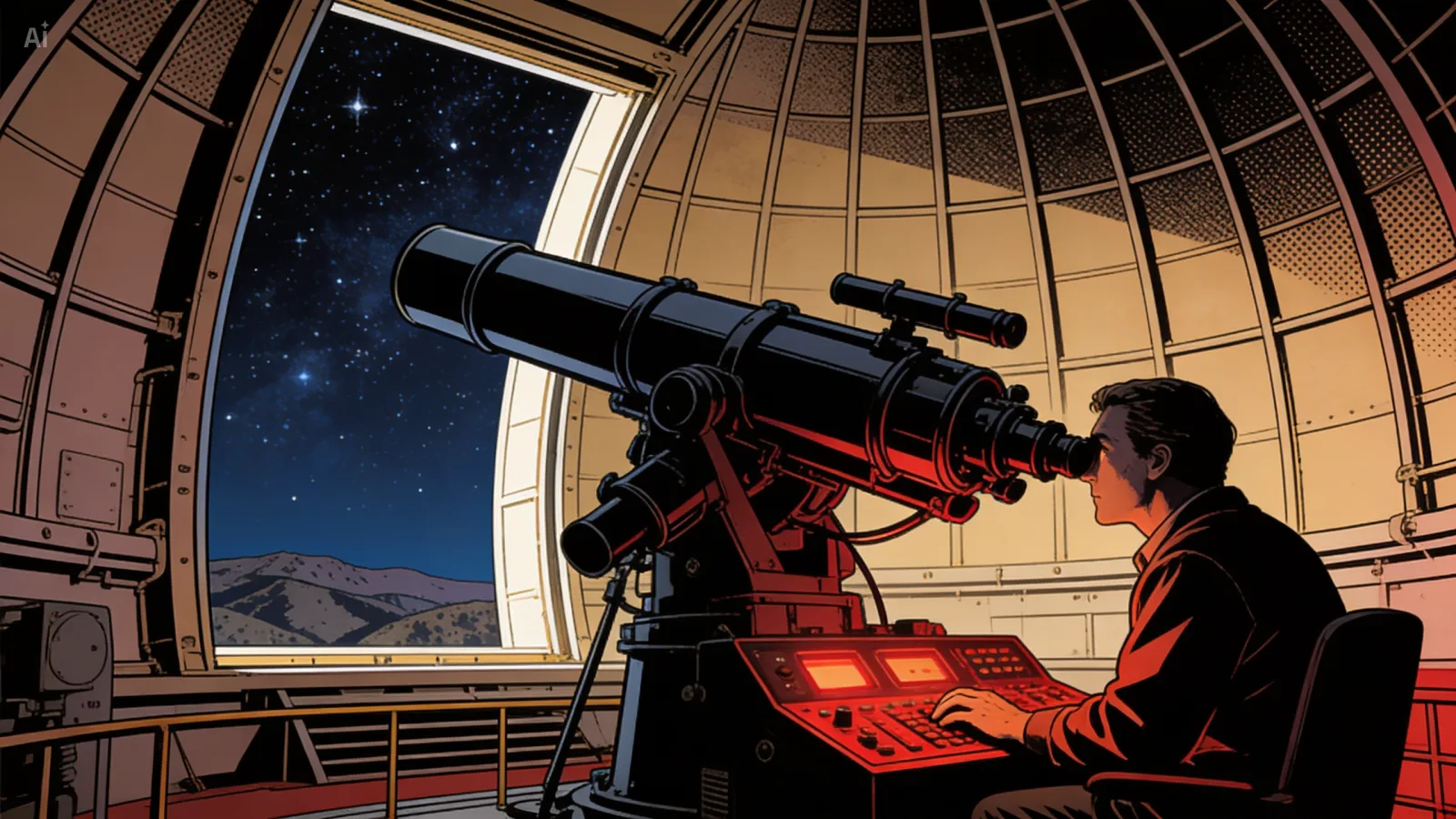
Five thousand feet above the orange groves and the Navy airfields of San Diego County, the most ambitious map of the sky ever attempted is about to begin.
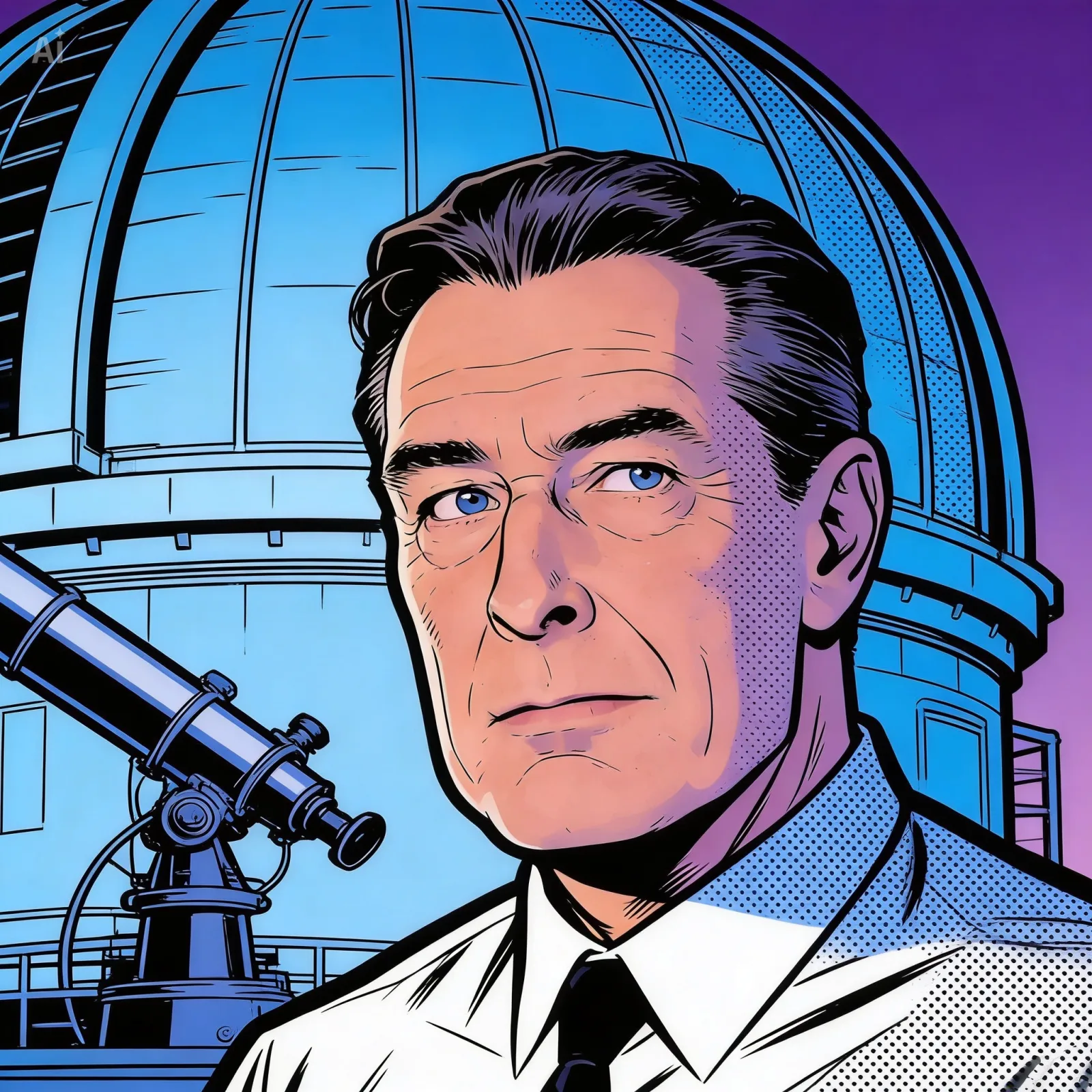
George Abell is a graduate student. From this observatory he will discover 2,712 galaxy clusters. But tonight, he just needs clear skies.
George is mapping a patch of sky. Each patch is photographed twice — once on a red-sensitive plate (fifty minutes), once on a blue plate (ten minutes). Two portraits of the same stars, in two colors of light, taken minutes apart.
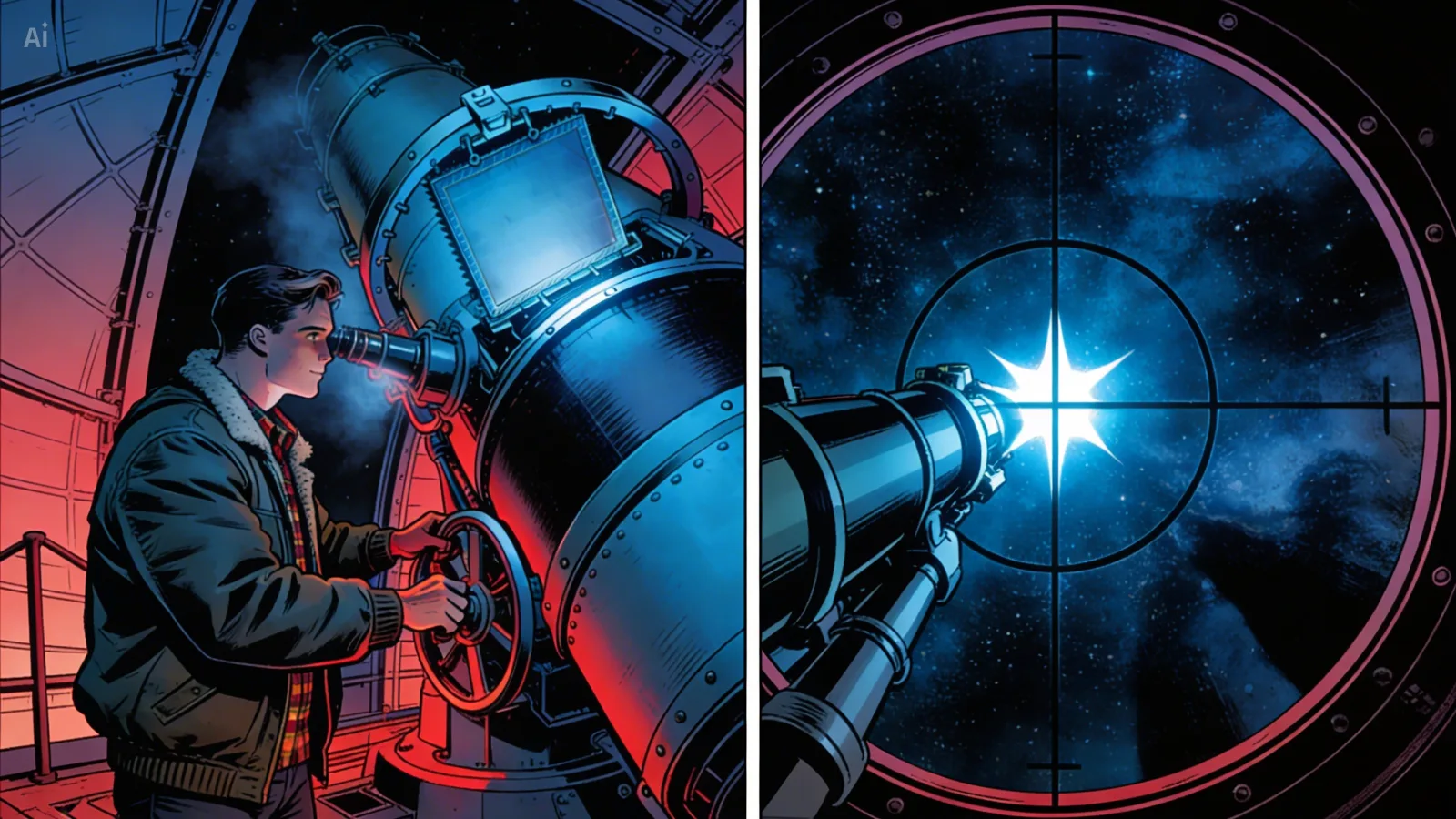
For each exposure, someone must sit at the guide telescope and keep a star centered by hand.
Fifty minutes. In the cold. Night after night, for seven years.
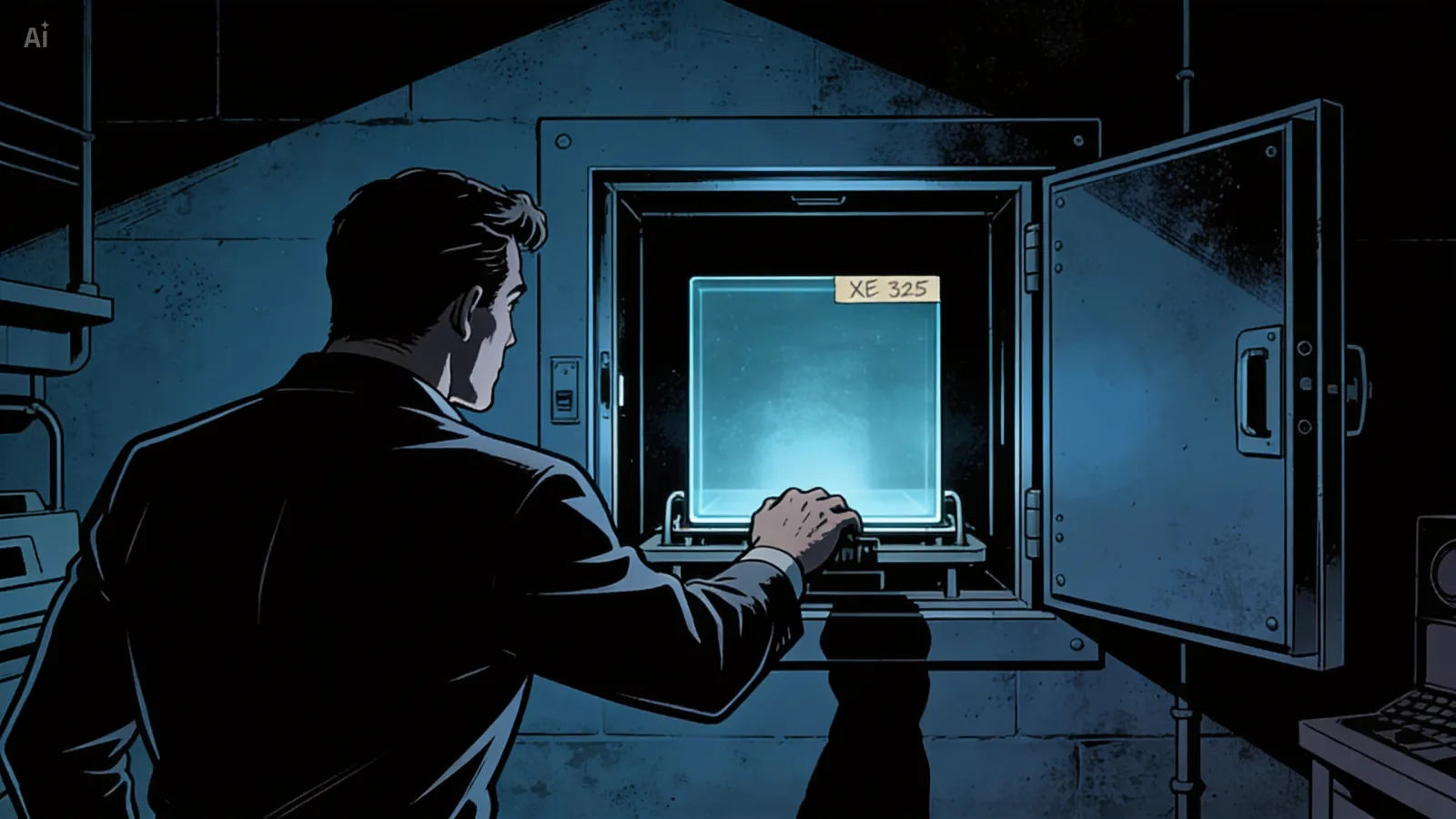
After the exposure, the plate rides a dumbwaiter to the darkroom. Development must happen in absolute blackness. No safelights — the emulsion sees every colour of light.
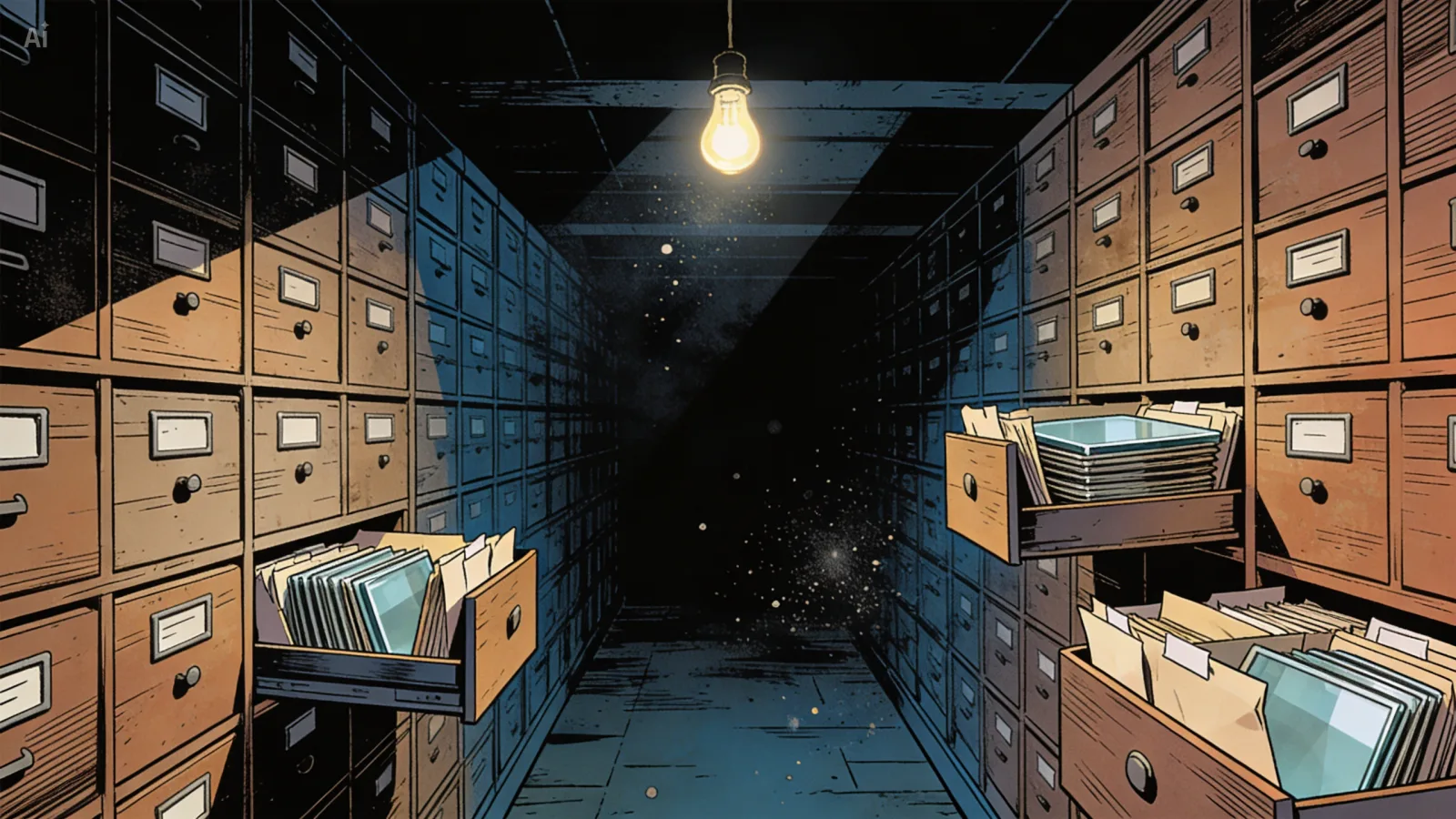
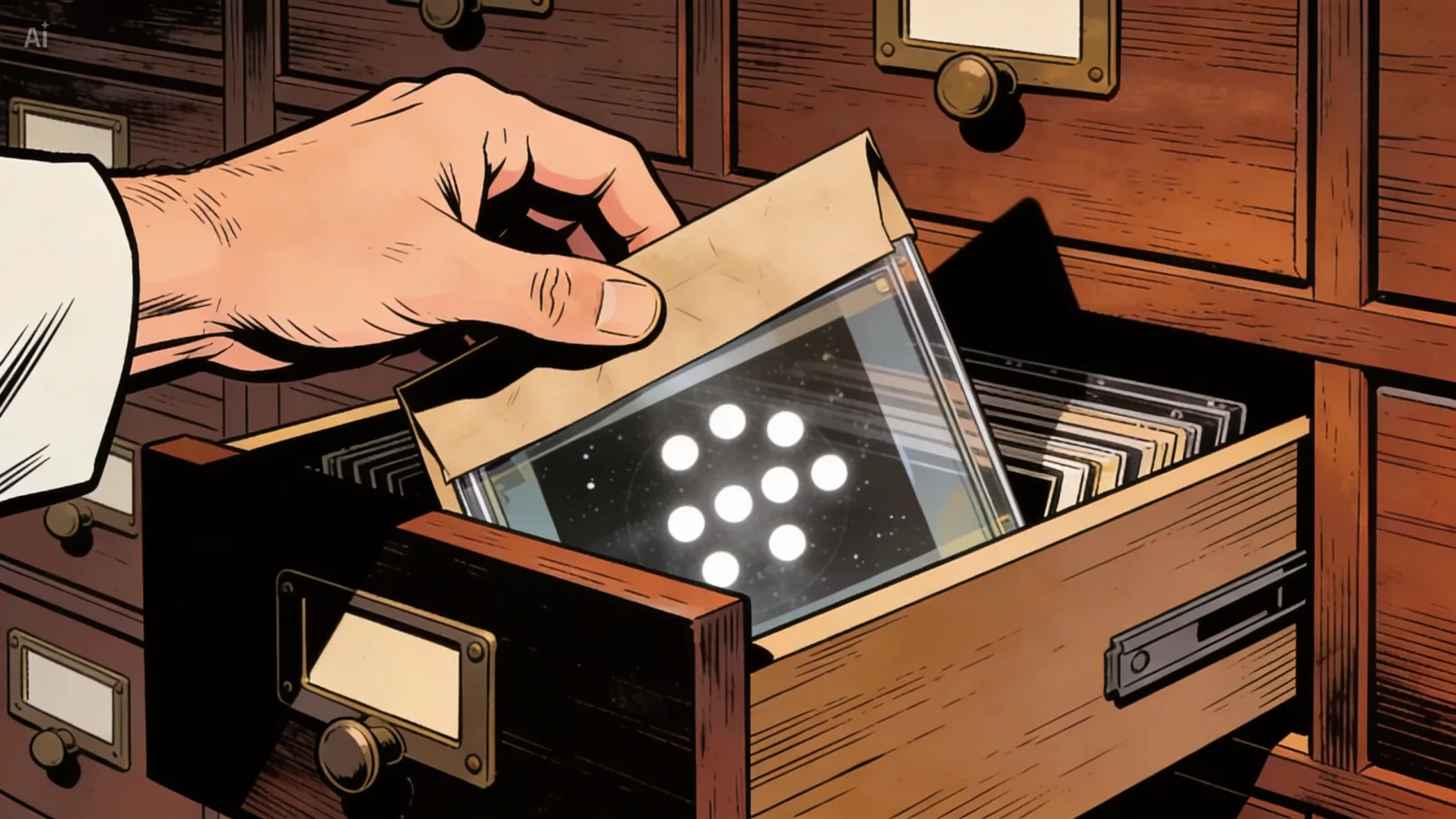
1,872 exposures will be taken; only 936 pairs will pass inspection. The survivors go into drawers where they will sleep for decades…
No one notices at the time, but there's a very strange anomaly…
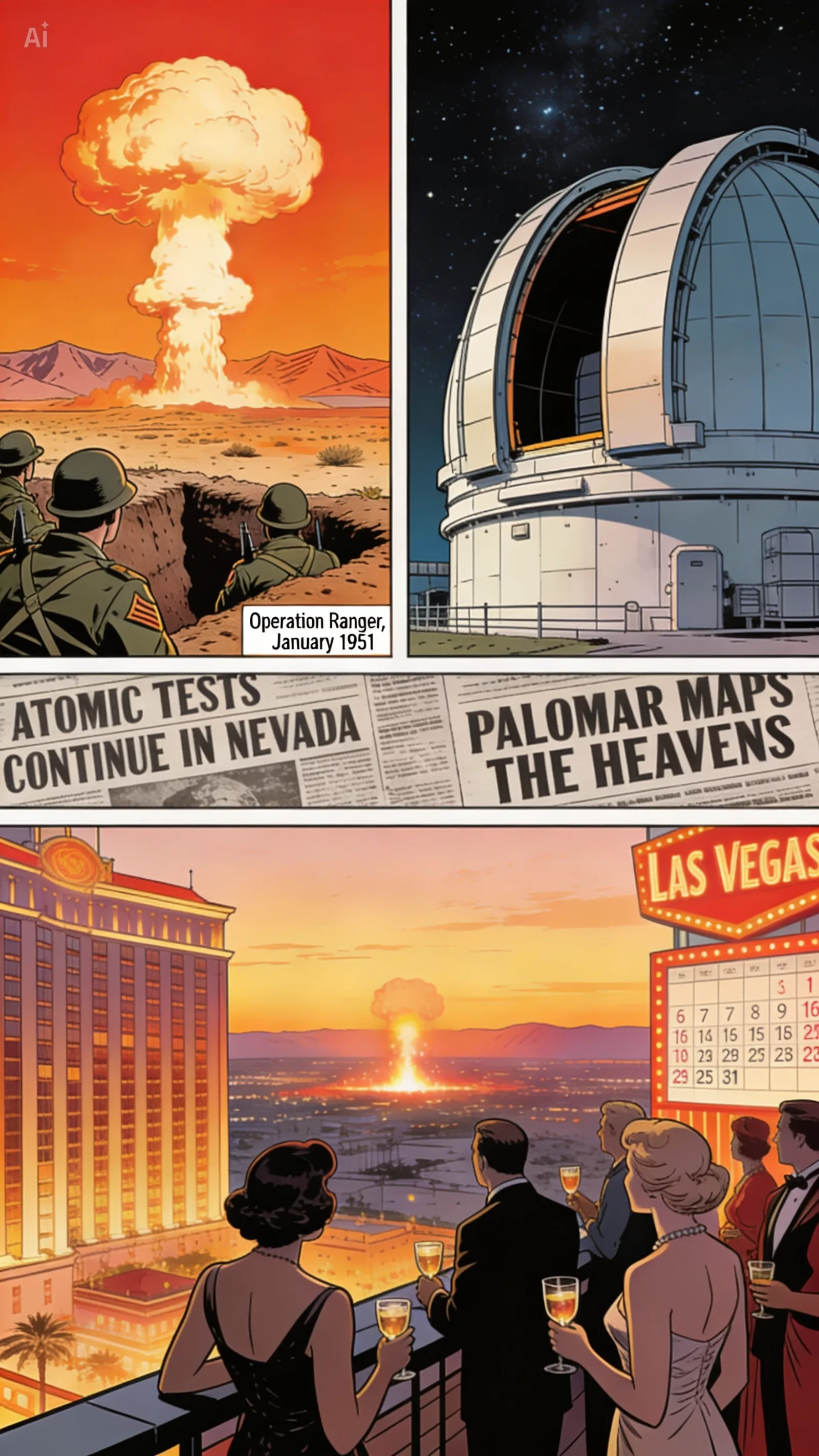
THE ATOMIC FLASH — 5:15 AM
Palomar Mountain at dawn. The dome is closed, the night's work done. On the northeast horizon — a sudden bloom of white-orange light. An atomic flash from the Nevada Test Site, 275 miles away. For a moment, the fir trees cast sharp shadows. Then darkness returns. The sky above is still full of stars.
And in the desert to the northeast, the United States is splitting atoms. The flash from Yucca Flat is visible from the mountain. The astronomers barely notice. They've been watching the sky all night — but looking the other way.
70 years later.
Chapter 1
The Vanishing
Uppsala · Zurich · The Canary Islands
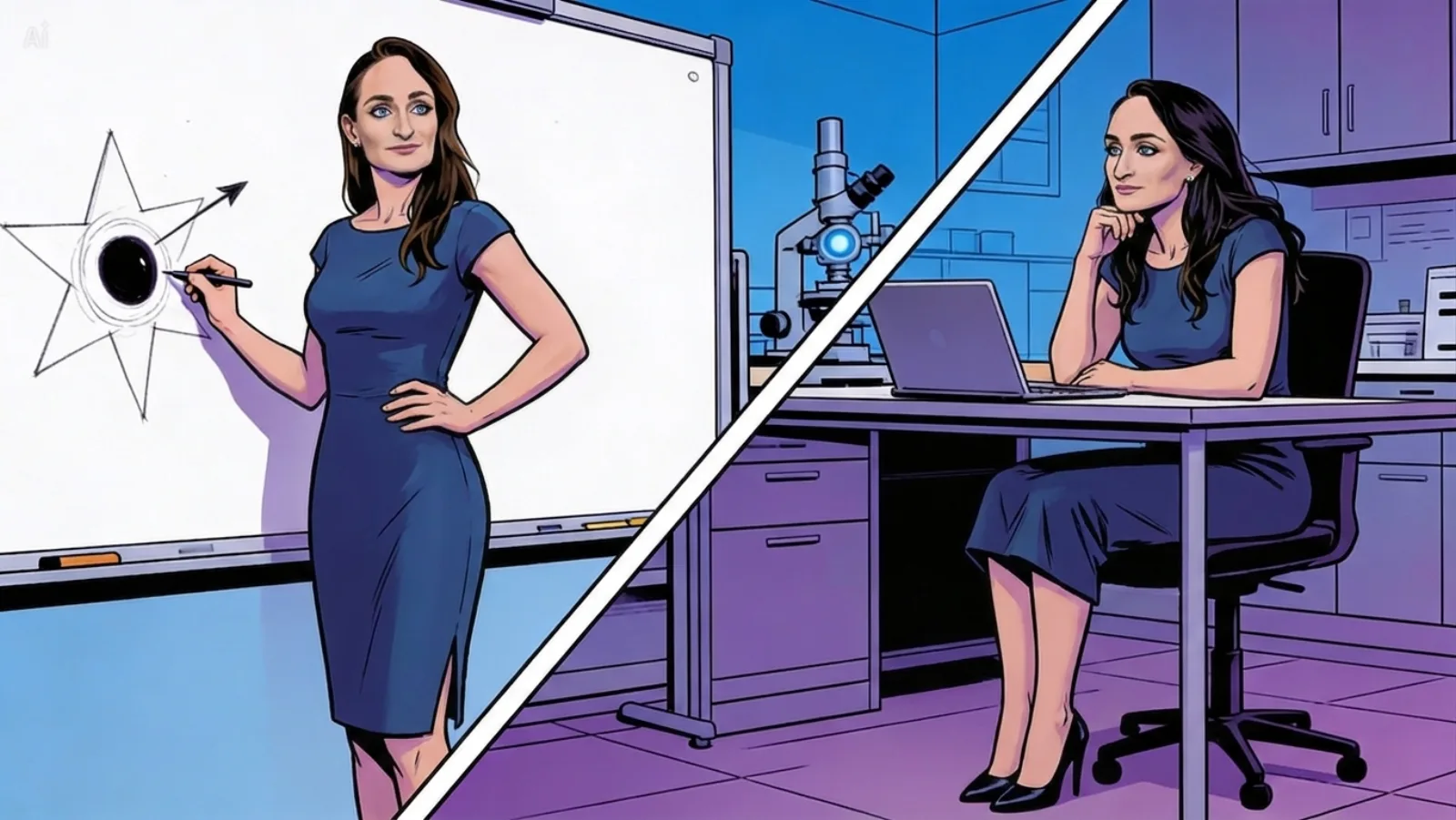
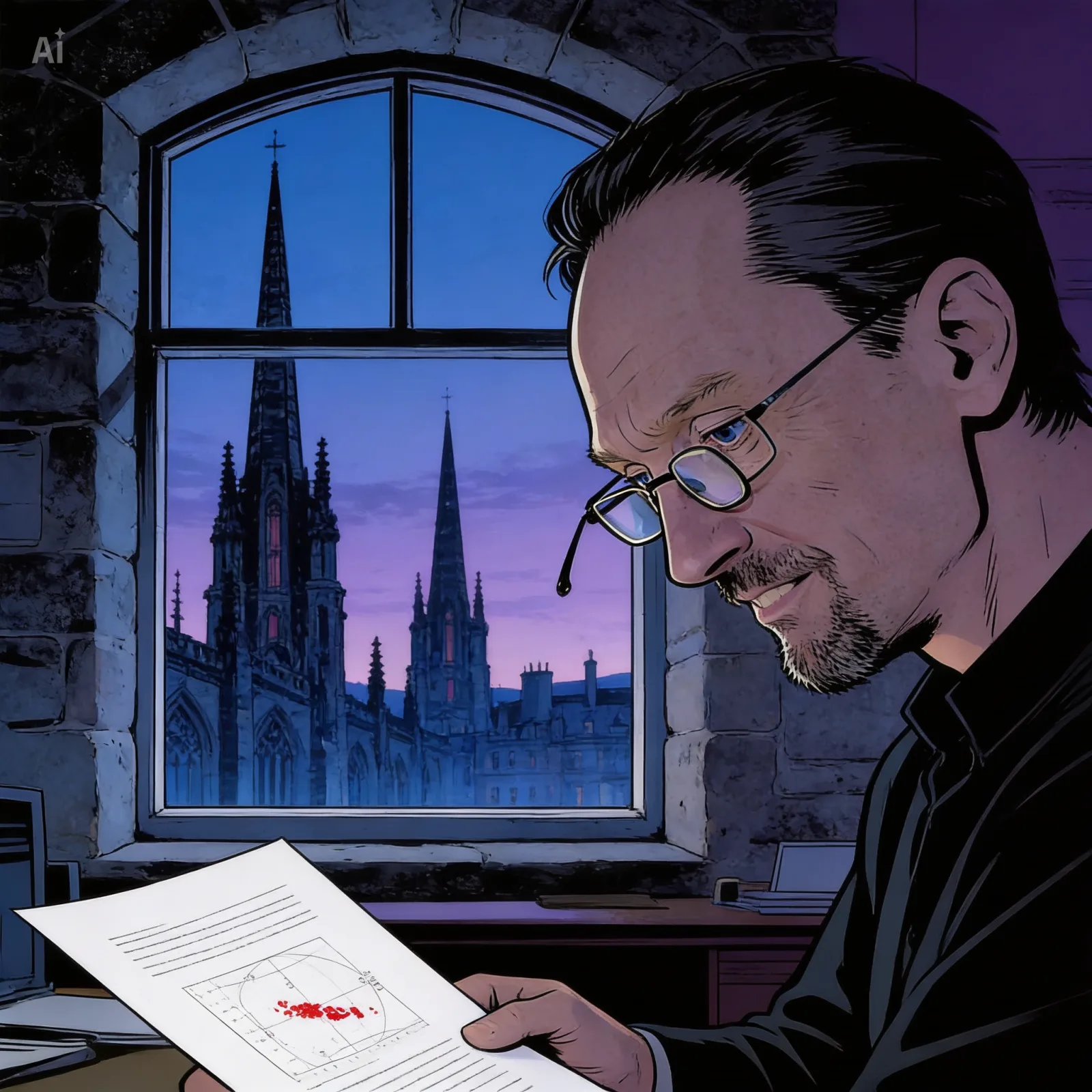
Dr. Beatriz Villarroel. A Swedish physicist turned astronomer. From her laboratory at NORDITA in Stockholm, she studies the violent hearts of galaxies — quasars, black holes, things that burn.
The loud death.
Most massive stars die loud — a supernova so bright it can be seen across galaxies. Light. Heat. A funeral with fireworks.
The quiet death.
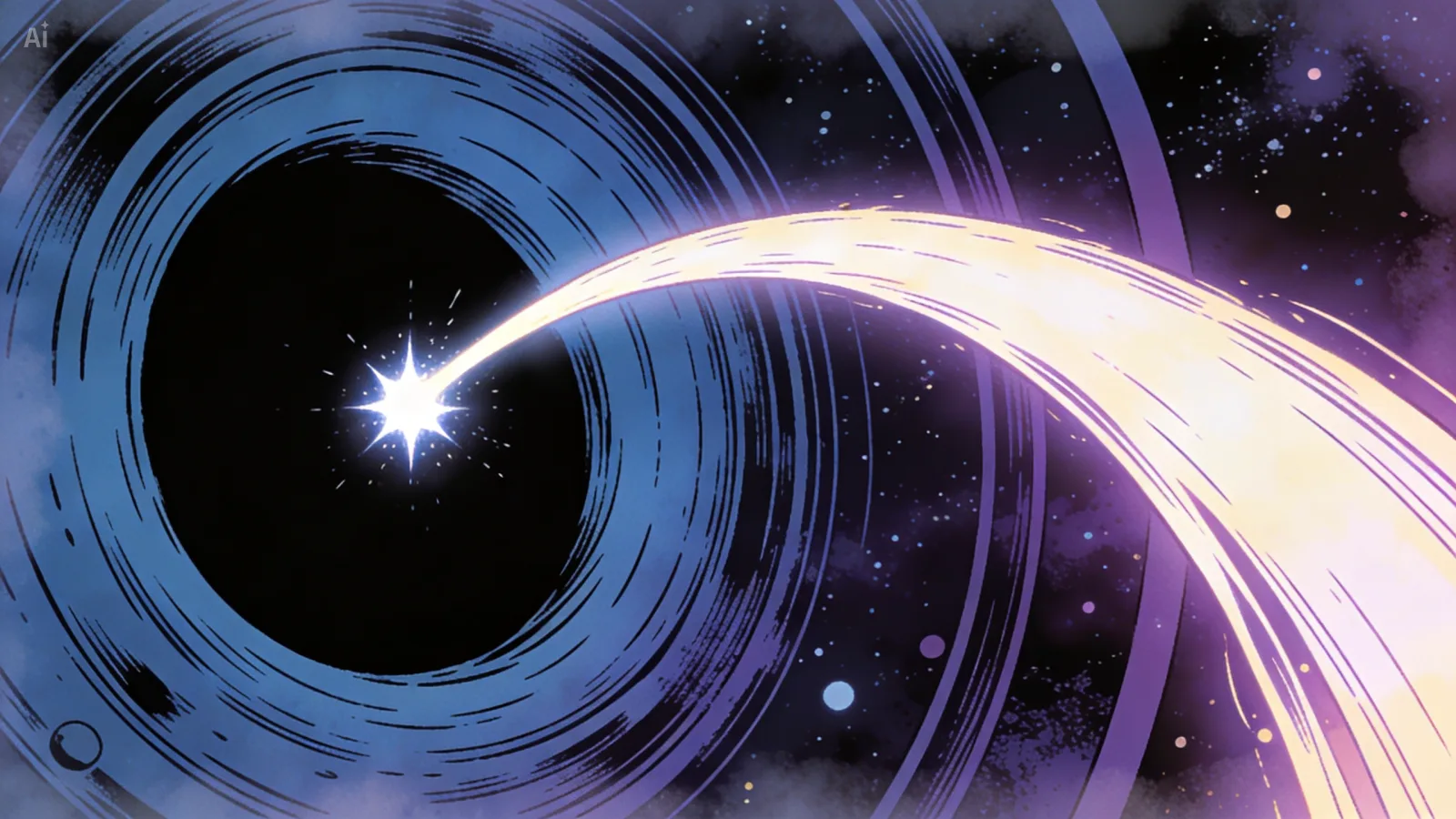
But what if one died quiet? Collapsed into a black hole without a flash? It would simply — vanish.
If a massive star collapses directly into a black hole — no supernova, no explosion — it would simply vanish from the record. Has anyone actually looked?
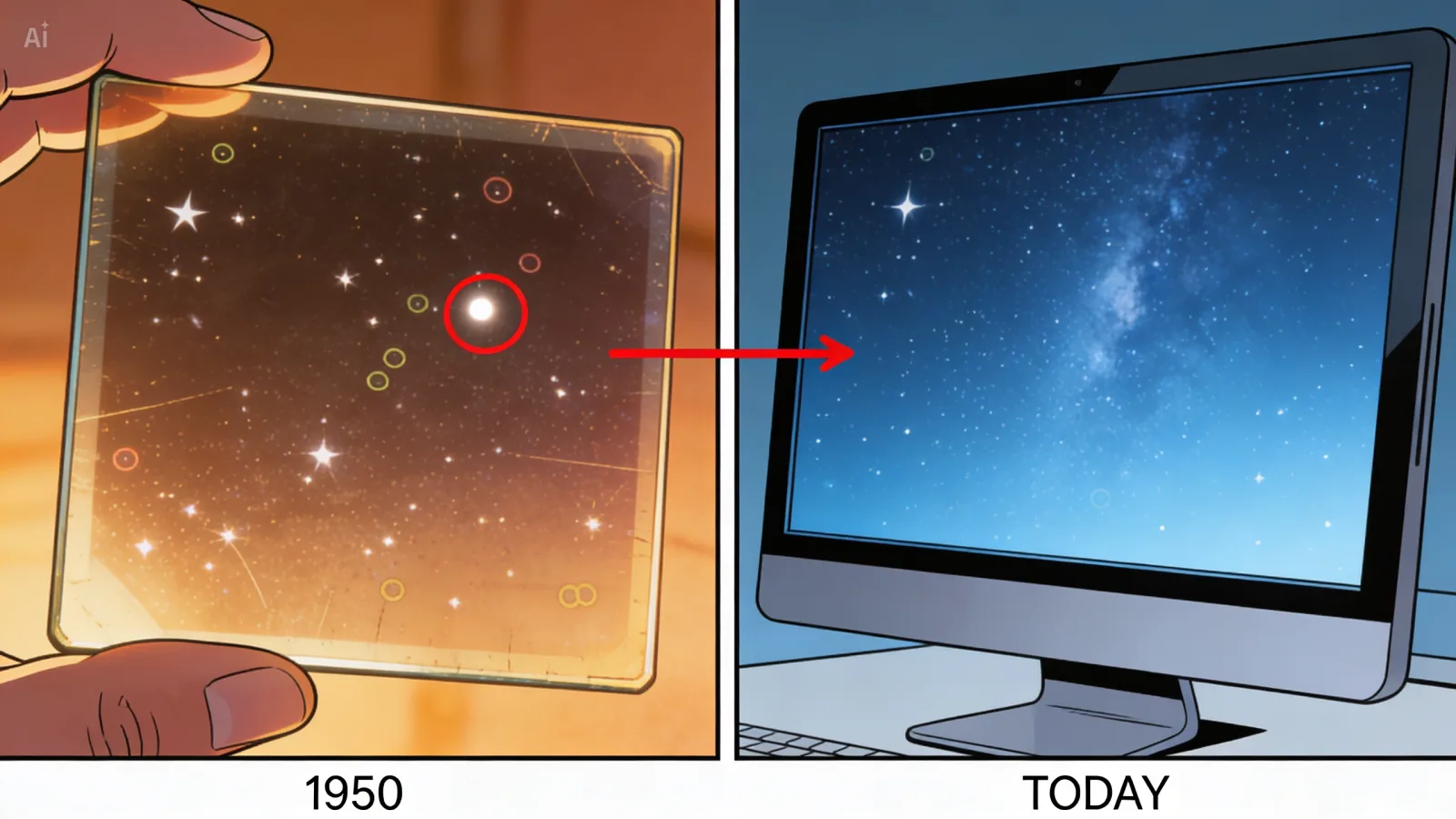
She proposes a research project: cross-match the sky as it was photographed in the 1950s with the sky as we see it today — and find the stars that have disappeared into black holes.
600 million objects.
She calls the project VASCO — Vanishing and Appearing Sources during a Century of Observations. She writes software to compare each speck of light in the 1950s sky with the sky we see today, looking for the ones that aren't there anymore.
Tenerife. Feb 2020.
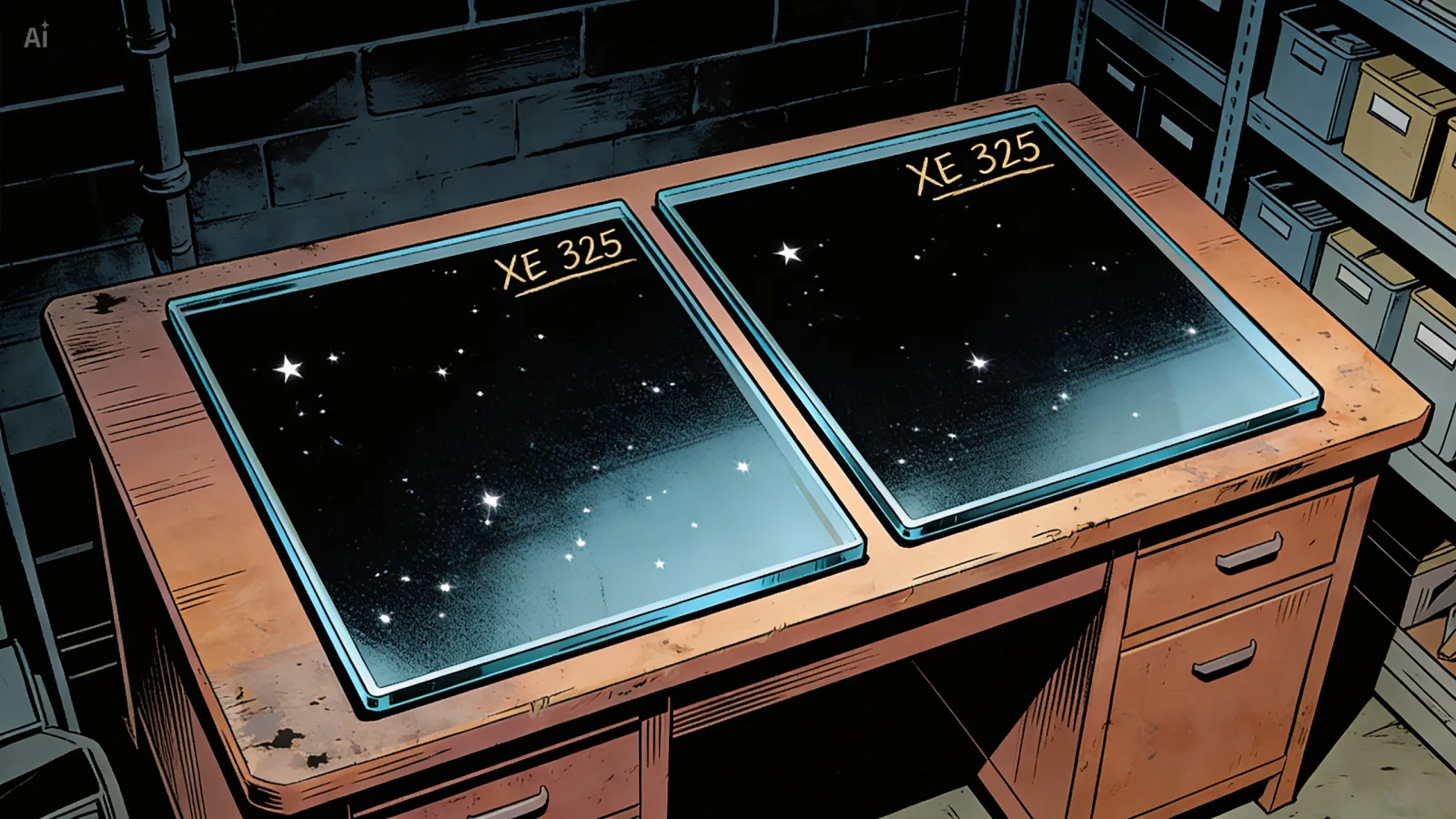
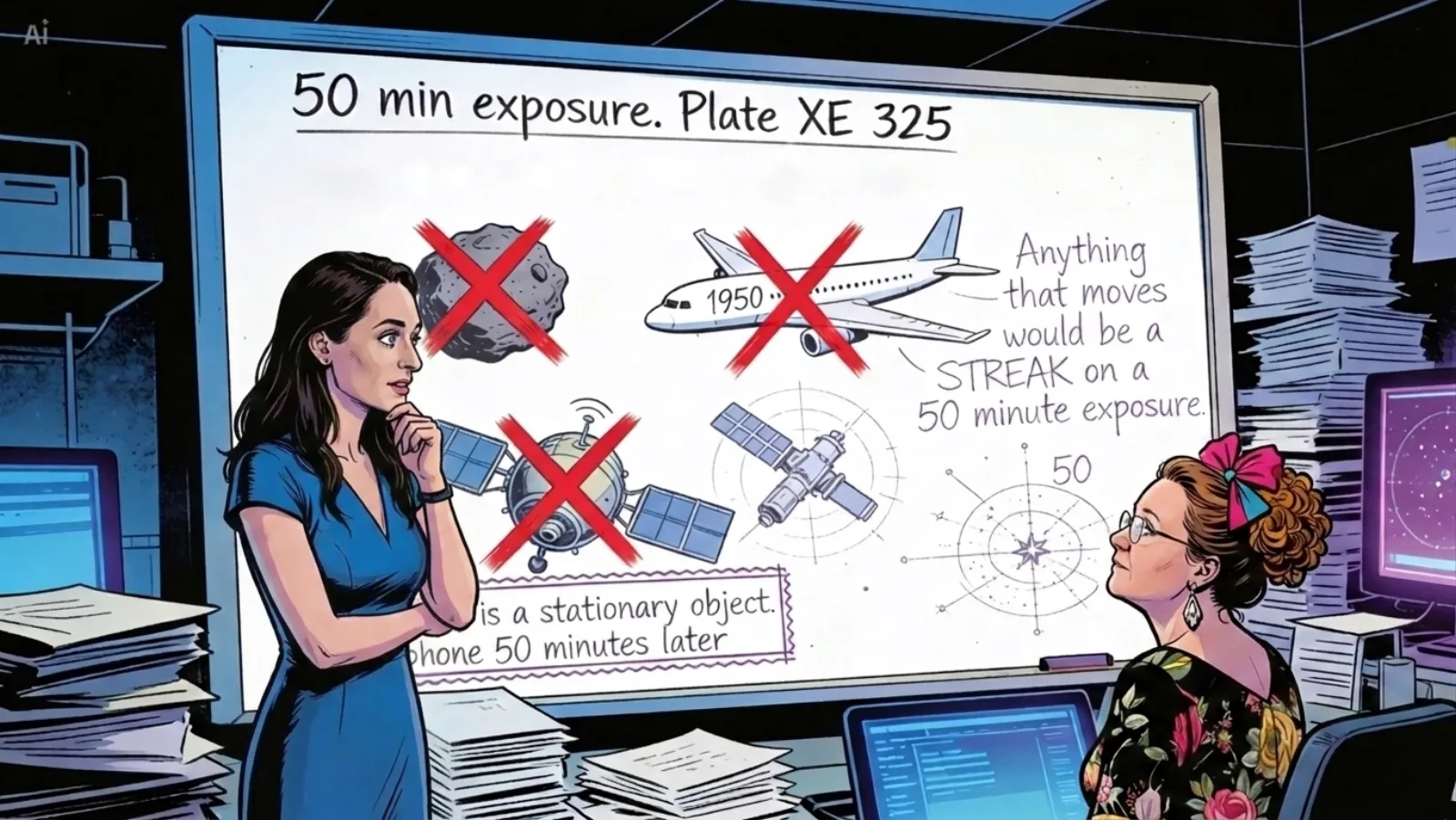
On her screen: Plate XE 325 — exposed at Palomar on April 12, 1950. The plate that went into the drawer.
Villarroel
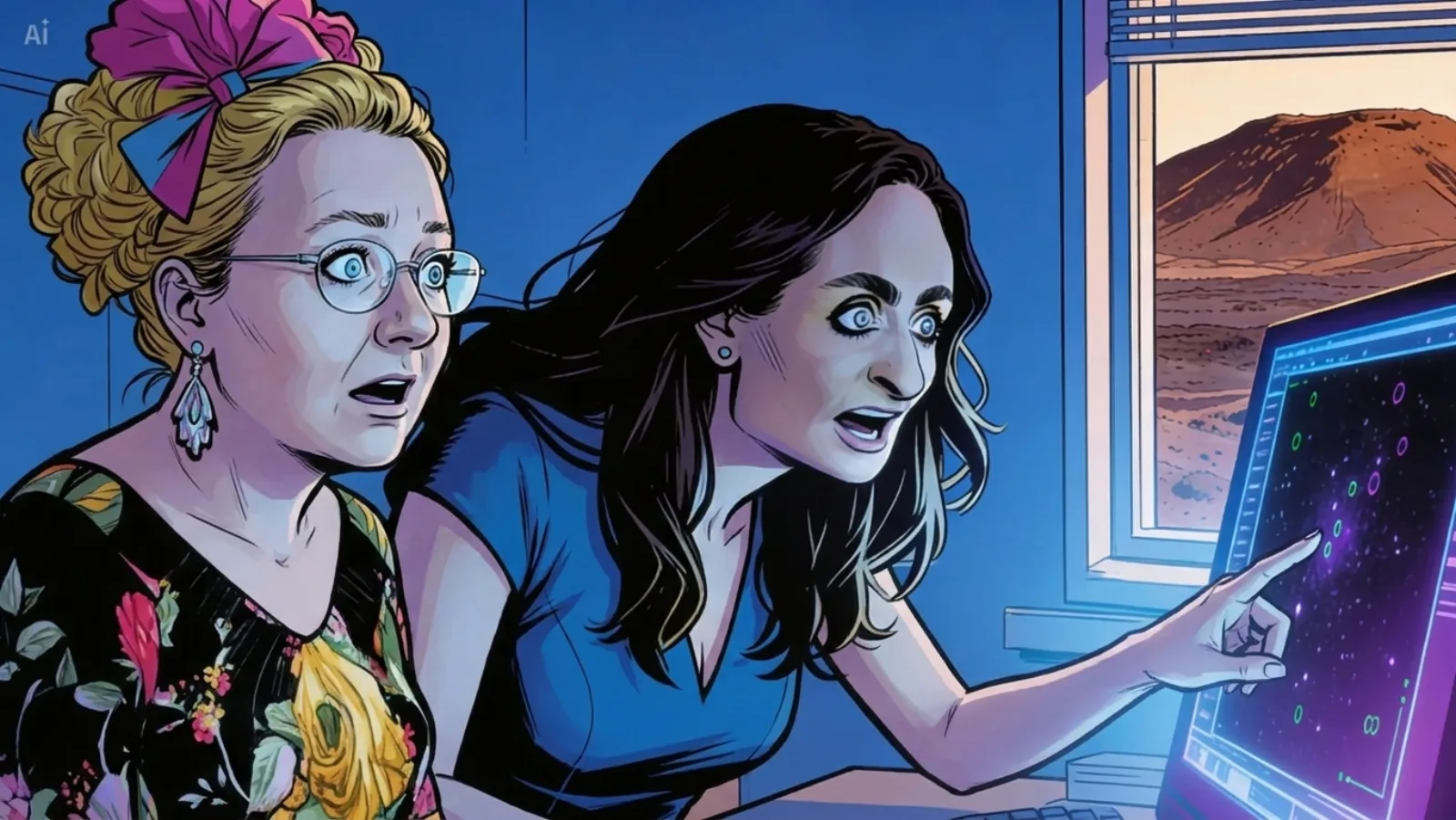
I was sitting there with my office mate in Spain... and I was just wondering, "So what is it? What are we seeing?"
— Penn State, "My Personal Journey Through the Unknown"
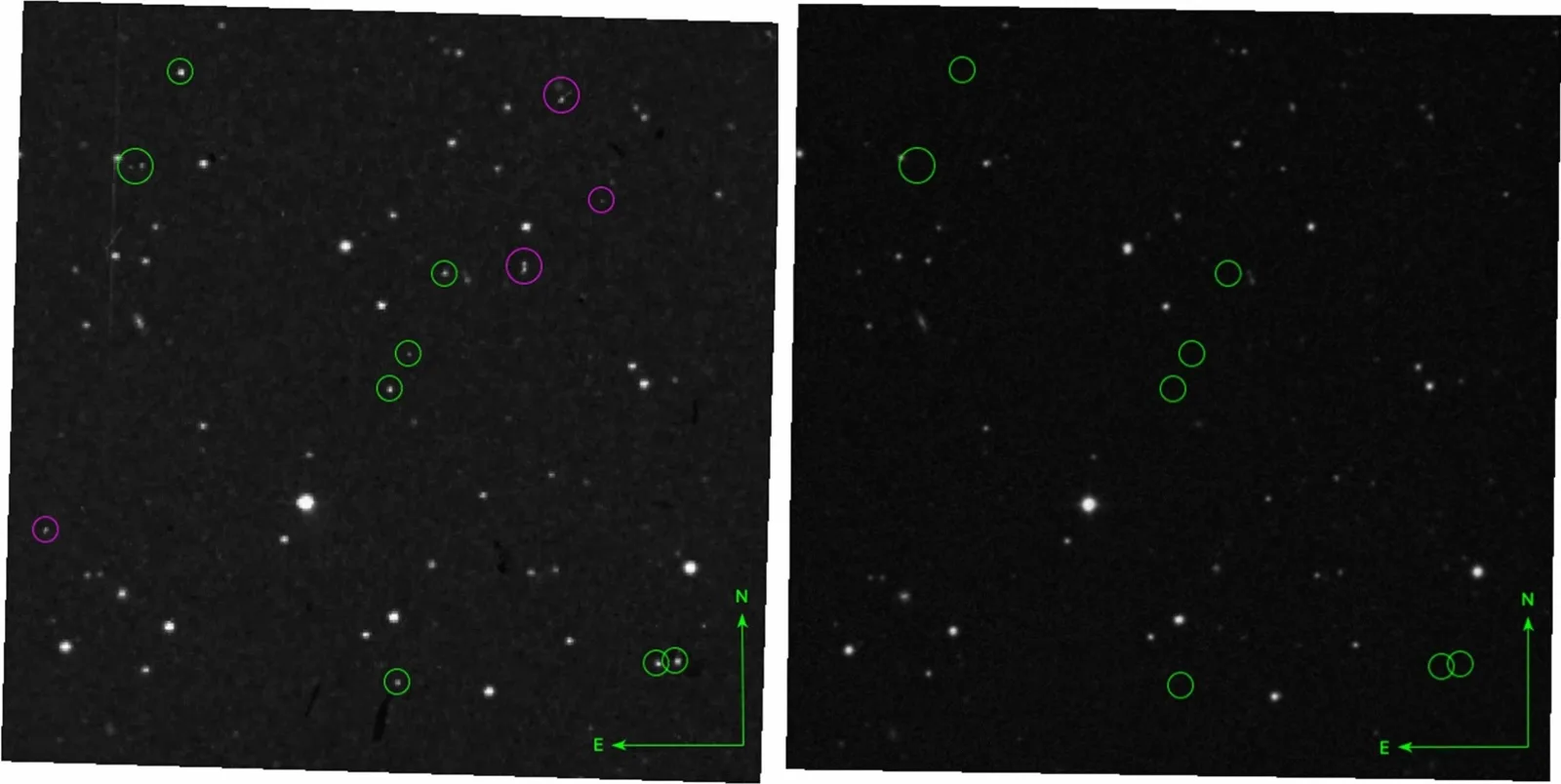
She sees them. Nine pinpoints of light. Clustered together on the red plate — completely absent on the blue companion plate taken thirty minutes earlier.
Exhibit A — Plate XE 325
Nine sources, clustered in a single patch of sky. Appearing within half an hour on a fifty-minute red exposure. Absent on the blue plate taken just moments before. Absent in every modern survey. Whatever it was — it's gone…
A note from the author
You're about halfway in. If this story is worth your time, drop a few dollars in the bucket — it's how I make the next one.
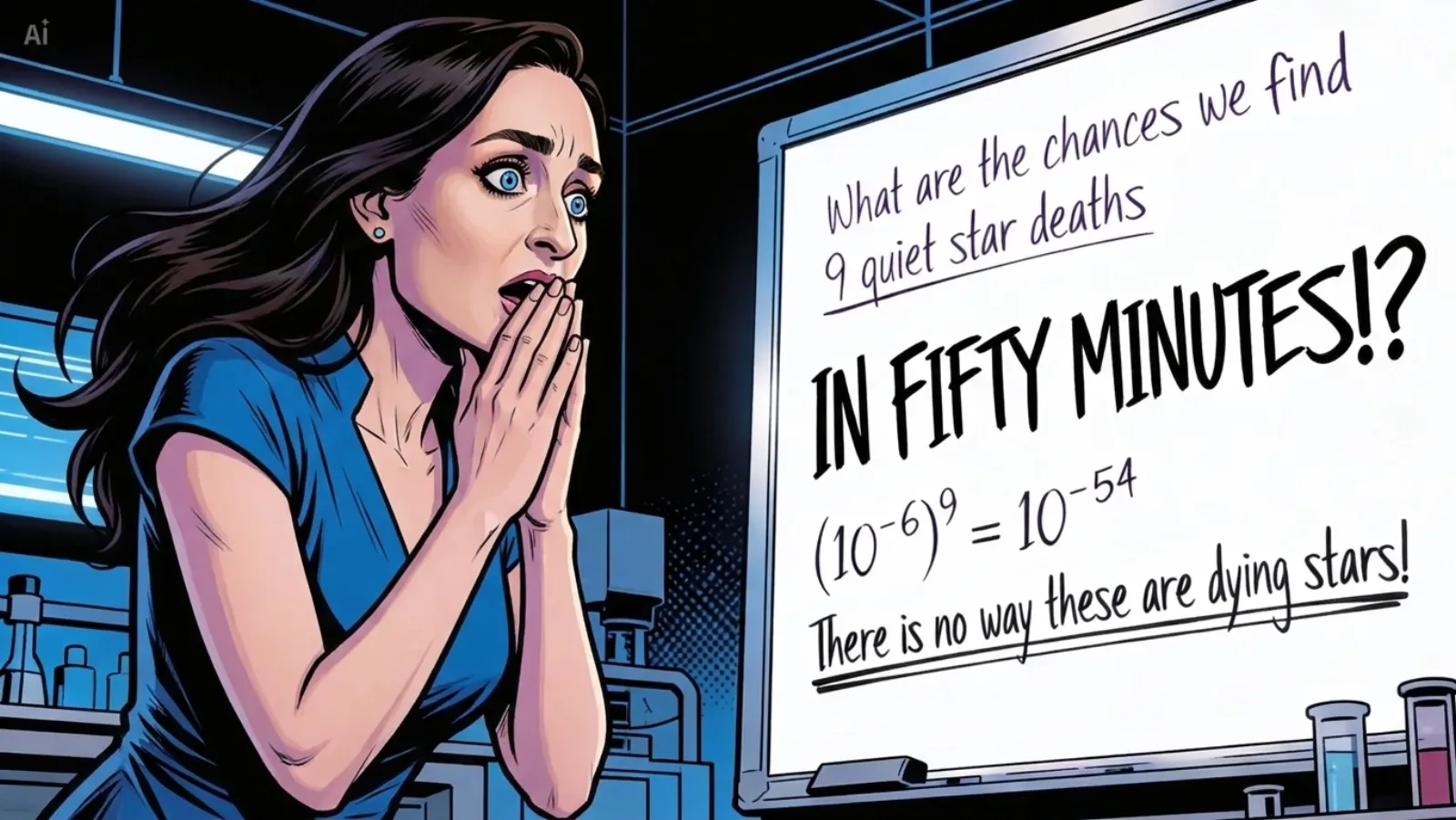
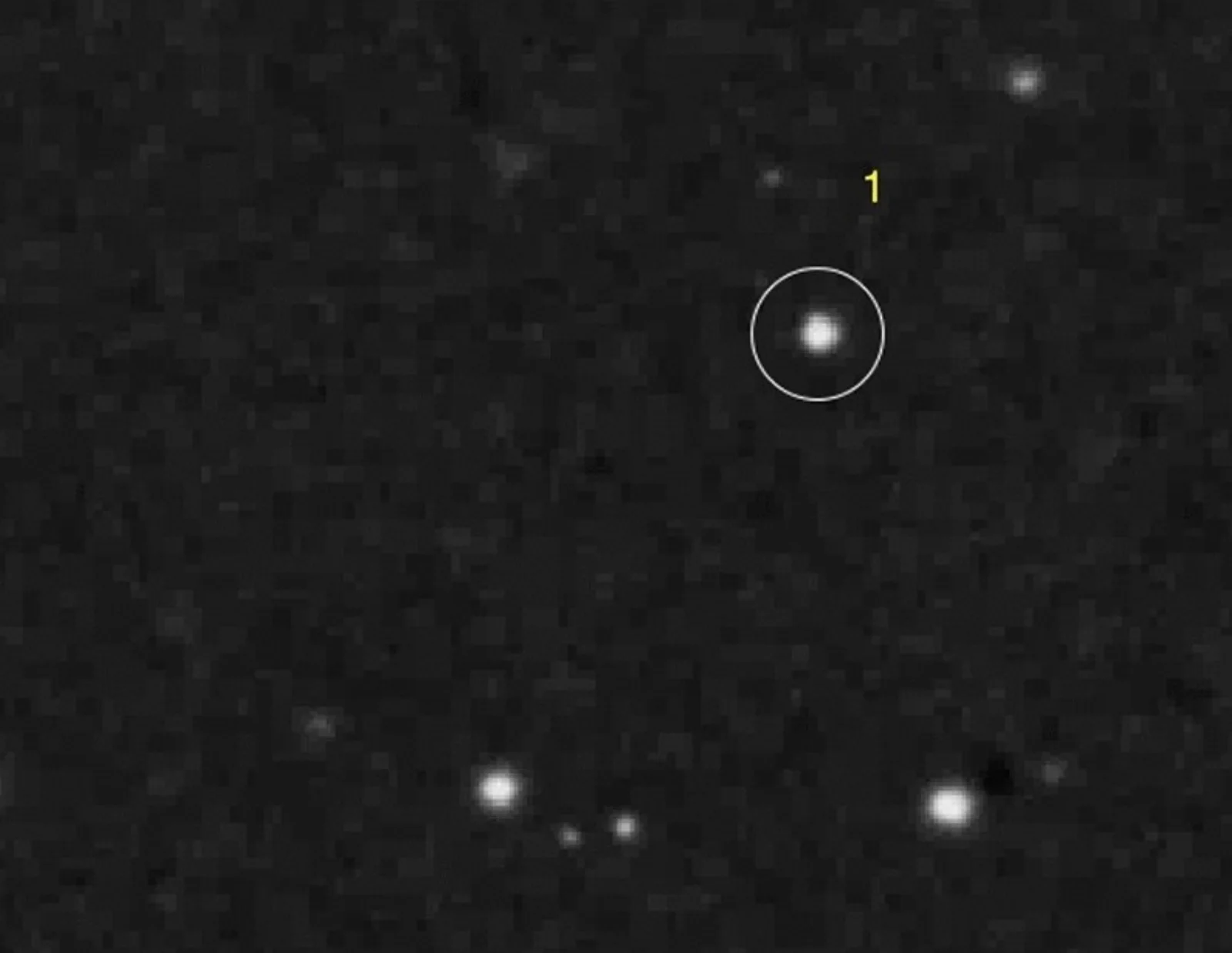
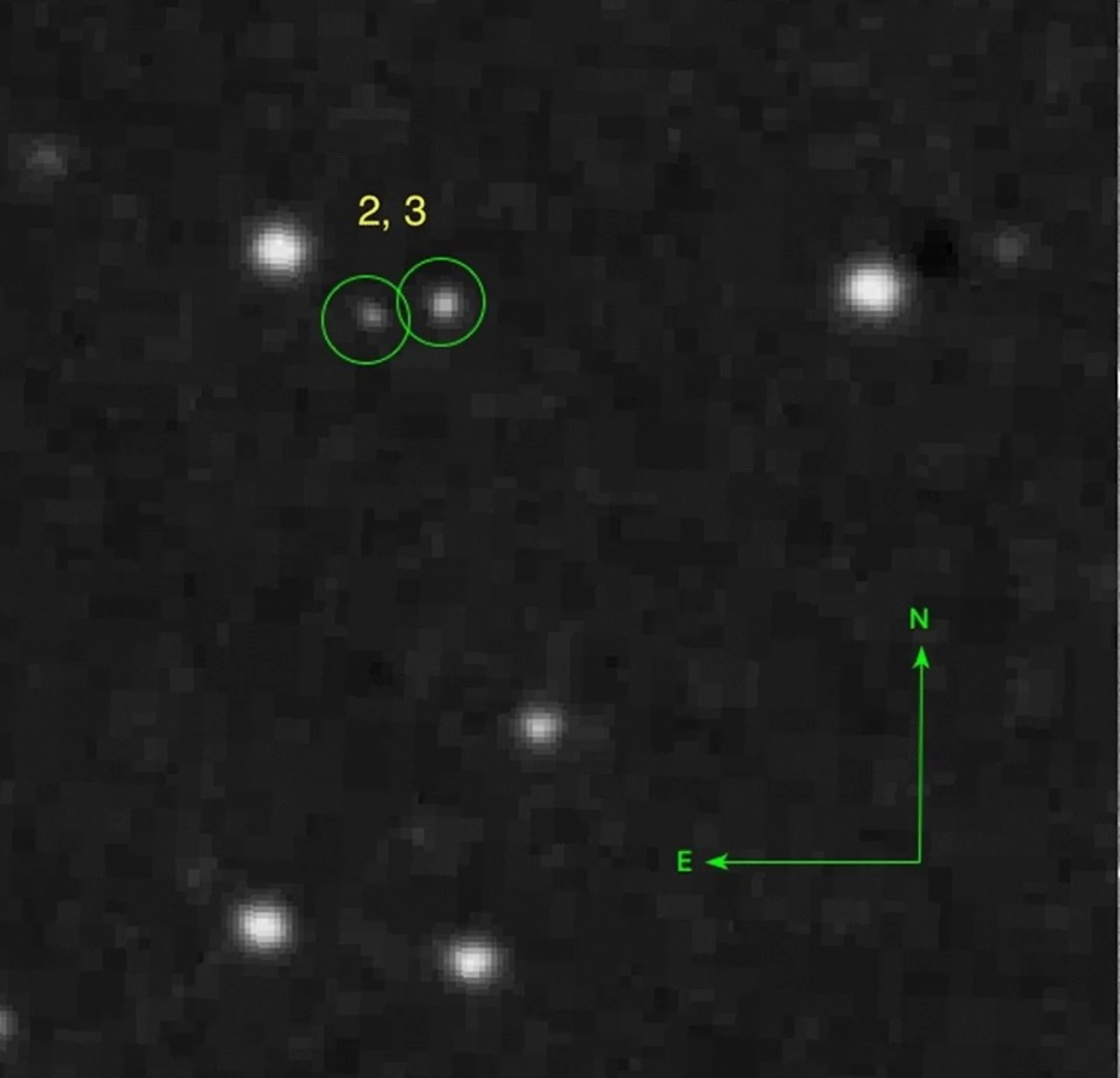
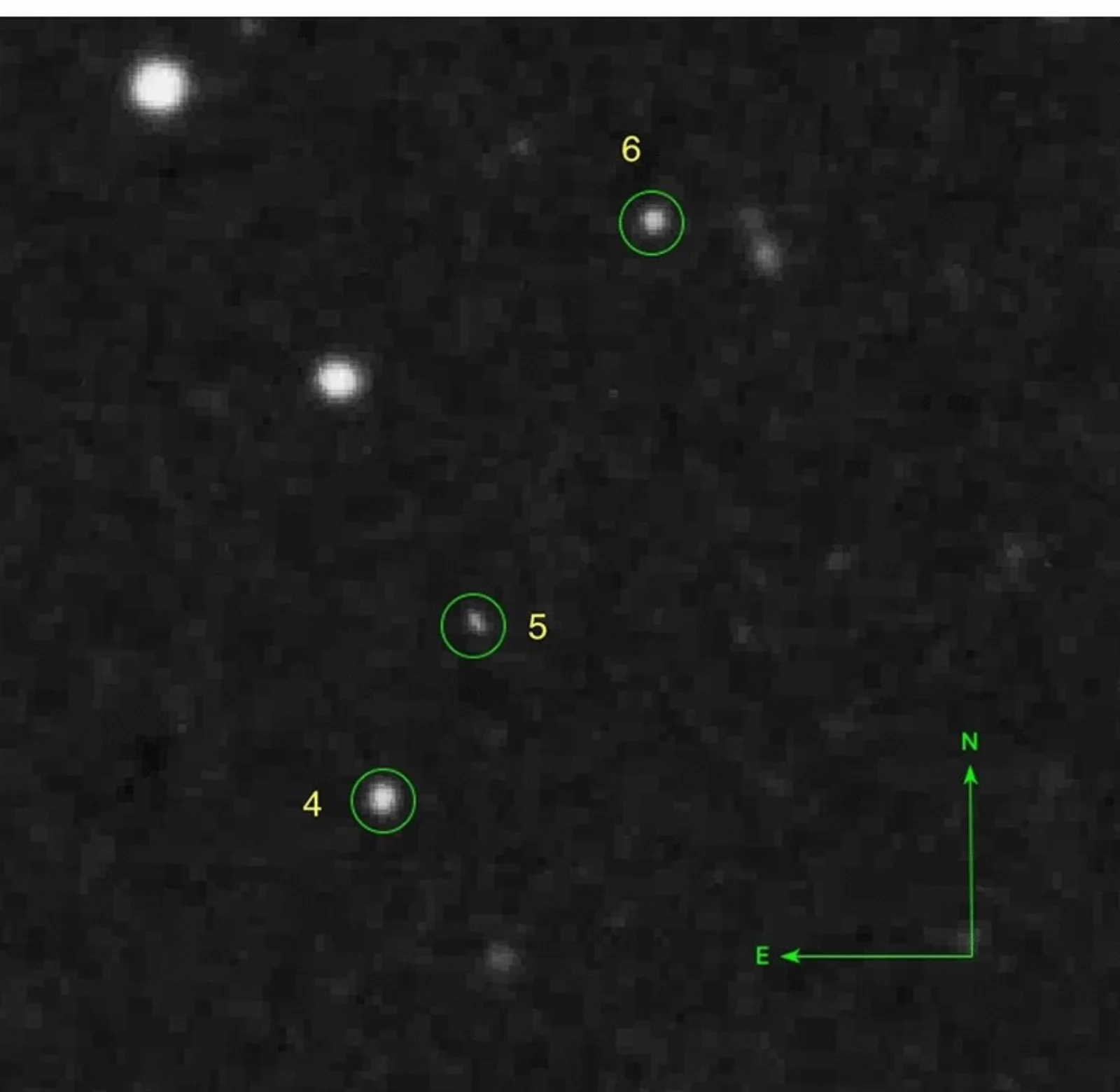
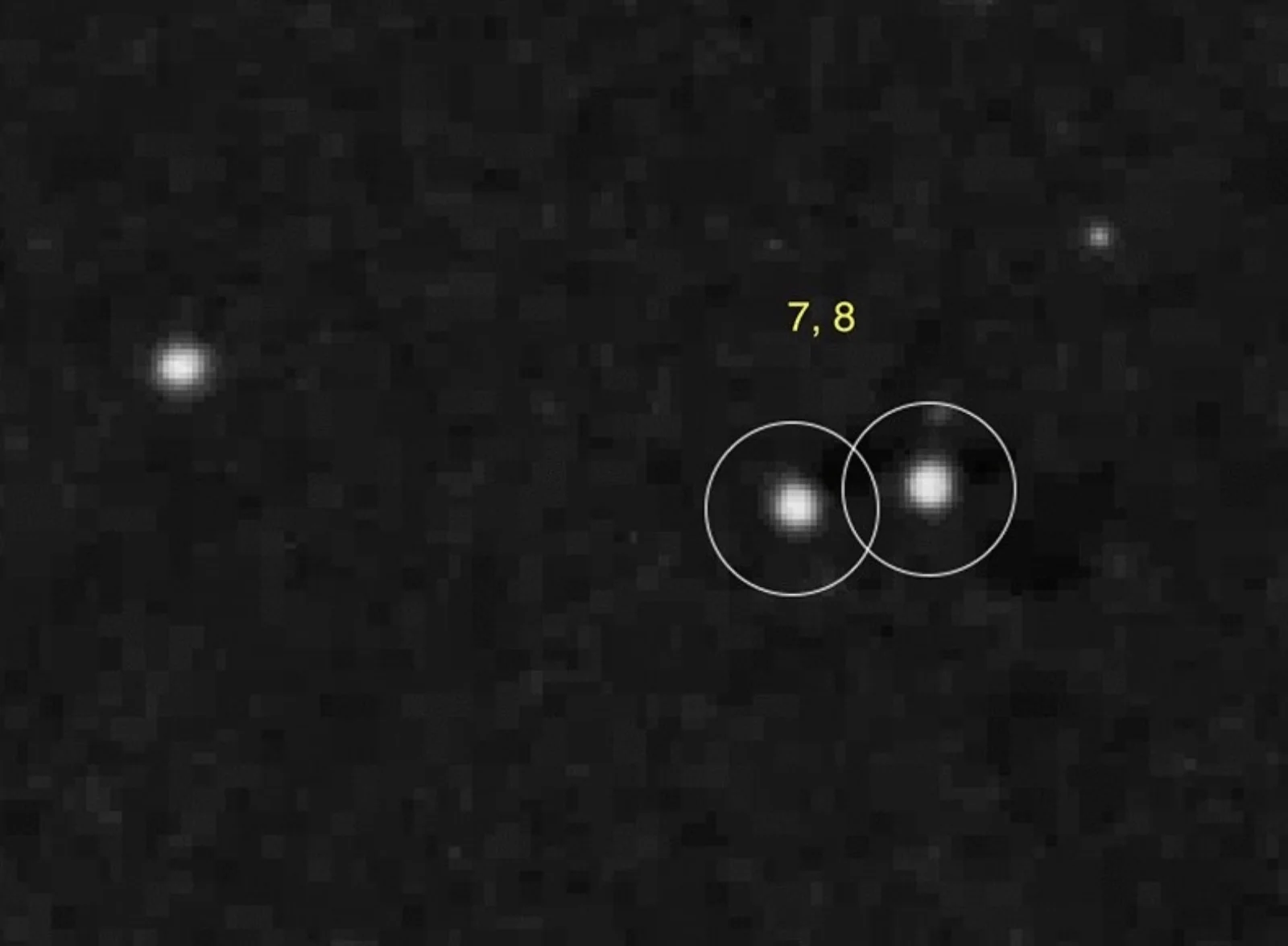
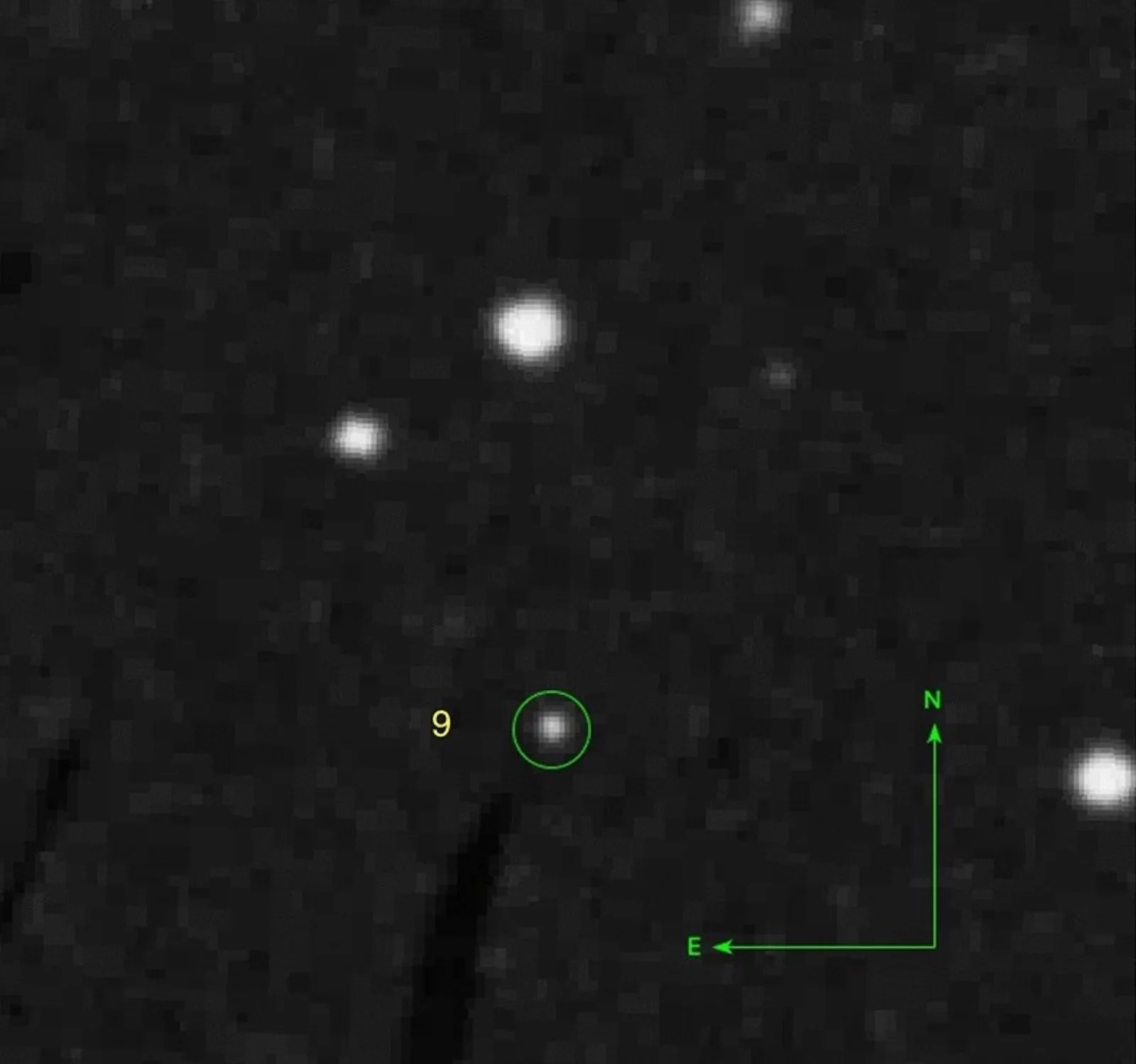
Nine point sources. Nine moments of light, photographed on a single mountain on a single night. Completely gone just moments later. Not there in modern images. Here they are, one by one.
TRANSIENT 1
TRANSIENTS 2 & 3
TRANSIENTS 4, 5, 6
TRANSIENTS 7 & 8
TRANSIENT 9
Are they satellites? If so — there's a big problem. — Cutouts from Villarroel et al. (2021), Scientific Reports, CC BY 4.0
From the paper.
"No satellites are known to have existed prior to the Soviet-made Sputnik in 1957 — seven years after the appearance of the transients in the 1950 POSS-I image."
— Villarroel et al. (2021), Scientific Reports, p. 6. ·
Read on nature.com
SO — WHAT ARE WE DEALING WITH?
"…more likely explained by a Solar system satellite of artificial or natural origin."
— Villarroel et al., Scientific Reports, 2021 — citing a precedent on a similar anomalous transient.
The paper has done what good science does: it has given the world something it cannot easily explain — and forced everyone, supporters and skeptics alike, to look harder.
After the paper, the search opens up.
She recruits thirty volunteers from six countries — not astronomers, just careful eyes — and teaches them to look. Together they examine fifteen thousand image pairs. The nine on Plate XE 325 weren't a fluke. The catalog grows.
QUIET MOMENT — NORDITA at night
Villarroel alone in her office at NORDITA. Night. Stockholm city lights through the window. She's looking at the screen but not really seeing it. Thinking.
Villarroel
Even if this turns out to be some new physical phenomenon, that's super exciting. That would mean we have discovered something new that nobody knew existed.
"It only takes one to be real and it changes humanity for ever."
— The Guardian
A bold claim is not enough. The science has to hold.
Chapter 2
The Shadow Test
First, the critics.
Edinburgh.
Dr. Nigel Hambly. Royal Observatory Edinburgh. He has a hypothesis — and he can prove it without ever looking at the sky.
The Scanner
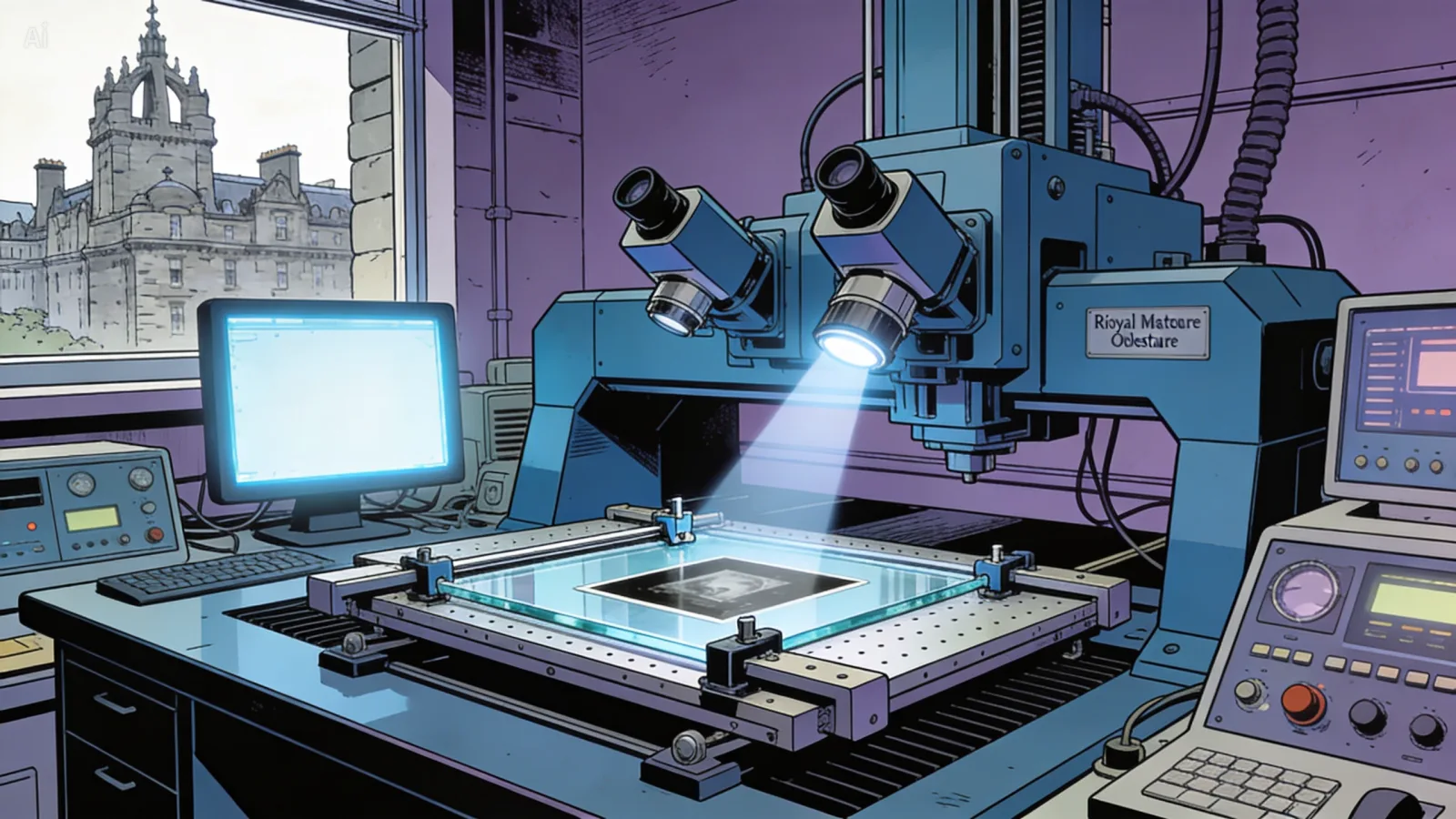
SuperCOSMOS, Edinburgh. The Royal Observatory's plate-measuring machine. It scanned the POSS-I plates at high resolution — and it's the scan Villarroel relies on for the close-up images of her nine transients.
The Copies
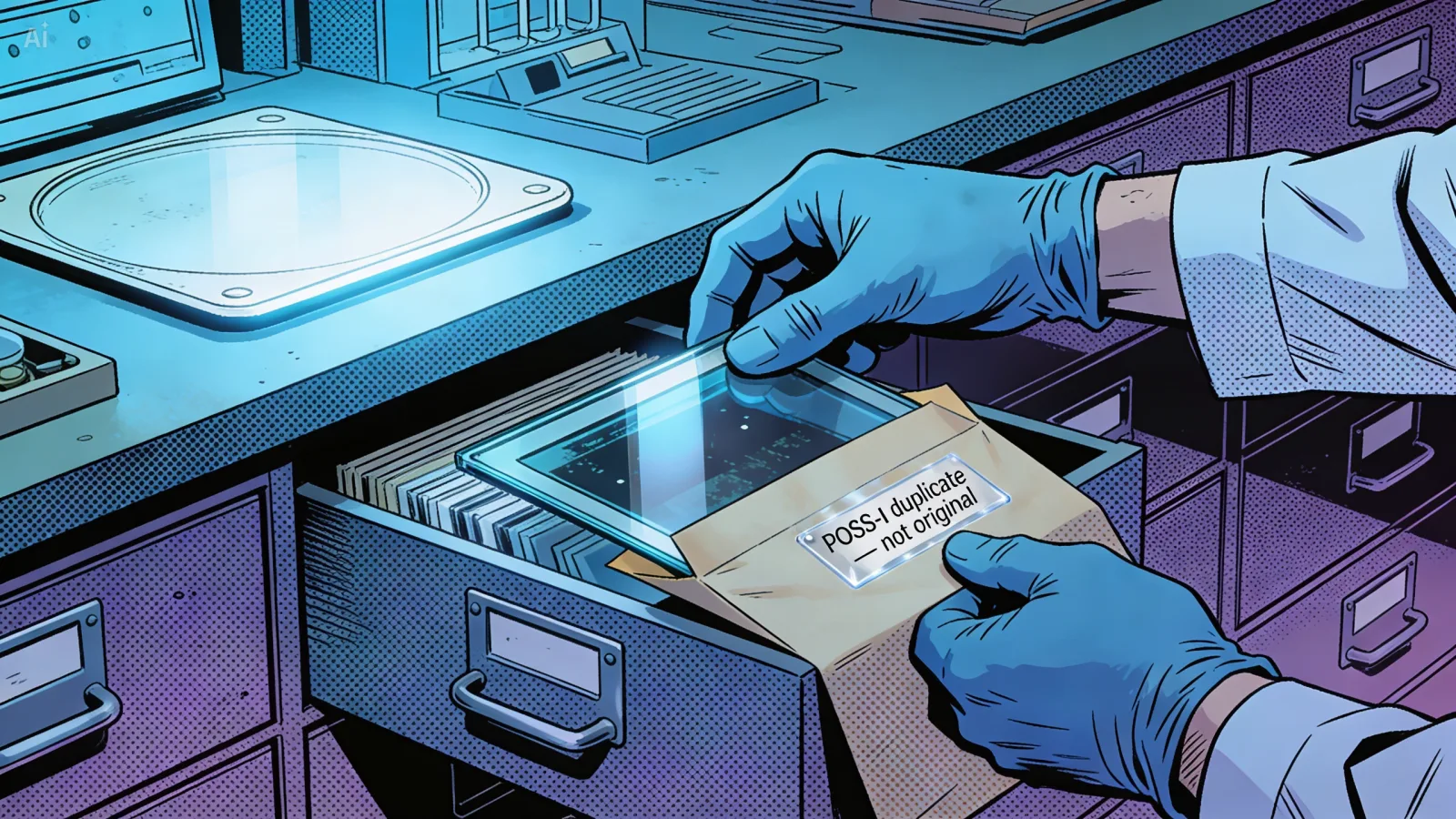
But Edinburgh never scanned the originals. They scanned glass duplicates. The originals still sleep in their drawers at Palomar.
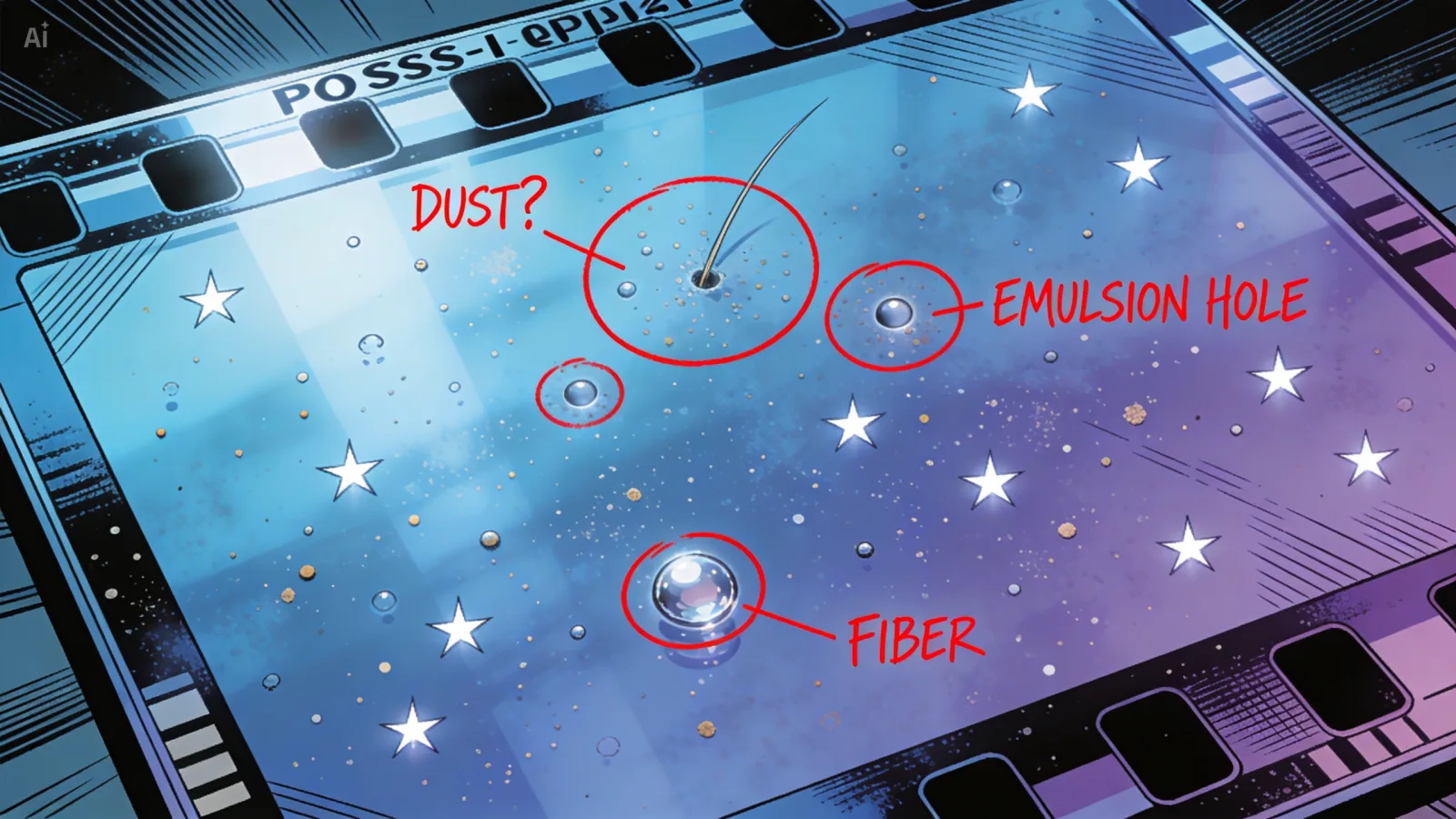
Hambly's argument: some of these "transients" may not be sky at all. They are dust, emulsion holes, fibres — defects in the glass copies, picked up at high resolution and indistinguishable from real stars.
"There'd be nobody happier than me if they are right. But I suspect they are wrong."
— Dr. Nigel Hambly, Royal Observatory Edinburgh
Back at Dr. Beatriz's laboratory.
She wants more data — either to shore this up, or to put the artifact problem to bed for good.
HER SOLUTION: A TEST TO PROVE THEY ARE REAL.
By now Villarroel's catalogue has grown well beyond the original nine — over 100,000 short-lived transients picked out of the POSS-I plates.
What are they?
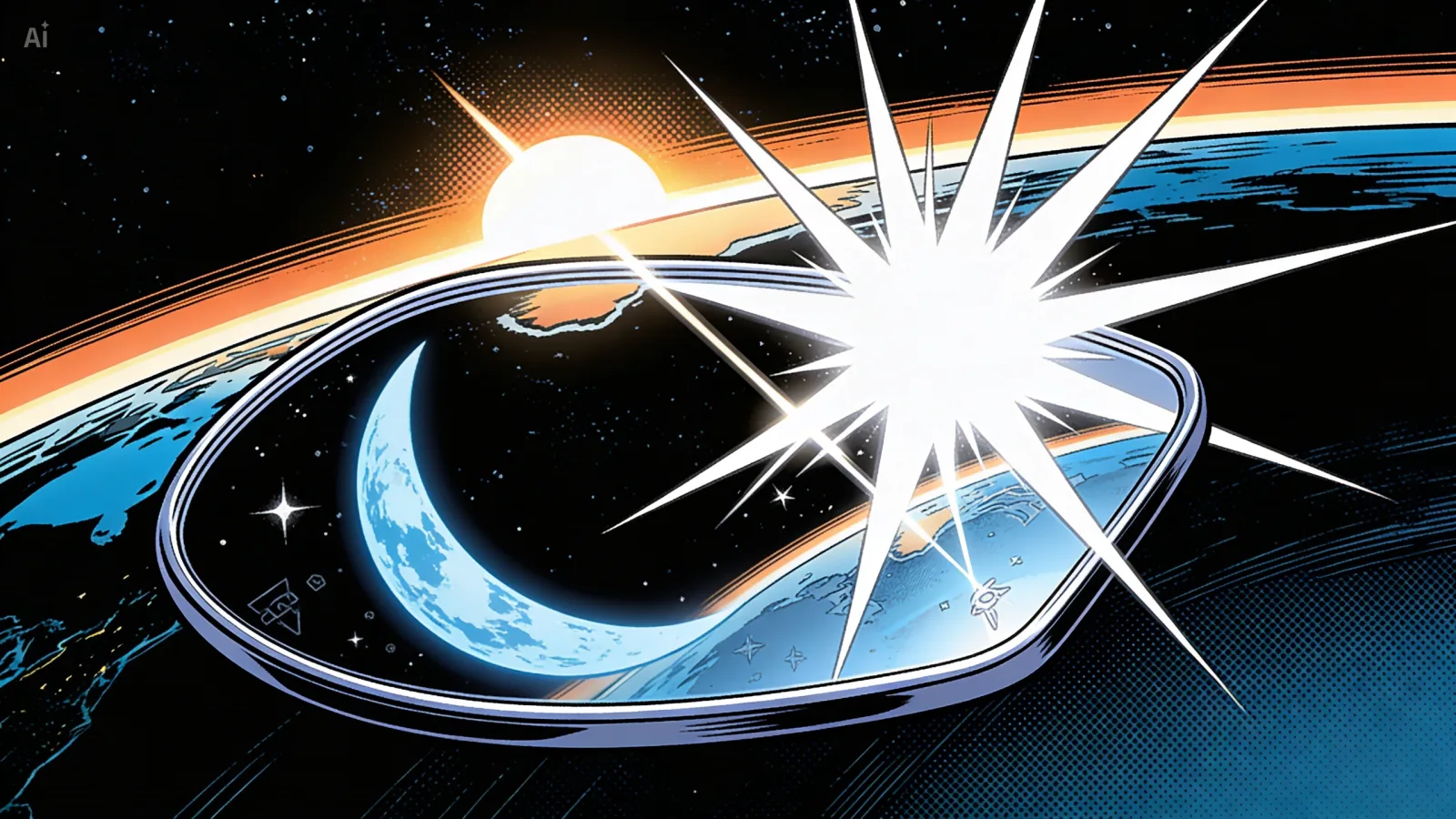
If the transients are real — if we're seeing sunlight glinting off actual objects in orbit — we can predict where they shouldn't appear. Earth always casts a shadow into space. Anything reflective inside that shadow has no sunlight available to reflect. It must go dark.
Sun on the left · Earth in the middle · Satellite in orbit · Palomar watching
So out of a hundred thousand candidate transients, fewer should land inside Earth's shadow than pure chance predicts.
Defects on the plate don't respond to a shadow — but real objects do…
In plain language: out of every thousand transients, you'd expect about eleven to land inside Earth's shadow by chance. Only three actually do. More than three times fewer than the sky should contain.
The 21.9 σ figure is statistician-speak for this is not a coincidence. The chance of getting a deficit this big from random data is, for all practical purposes, zero.
The conclusion is hard to escape: these flashes are real, reflective objects orbiting the Earth.
The plates with the most transients seemed to be the ones taken close to the days the United States detonated atomic weapons. A hunch. She needed help to test it.
Nashville. Vanderbilt University.
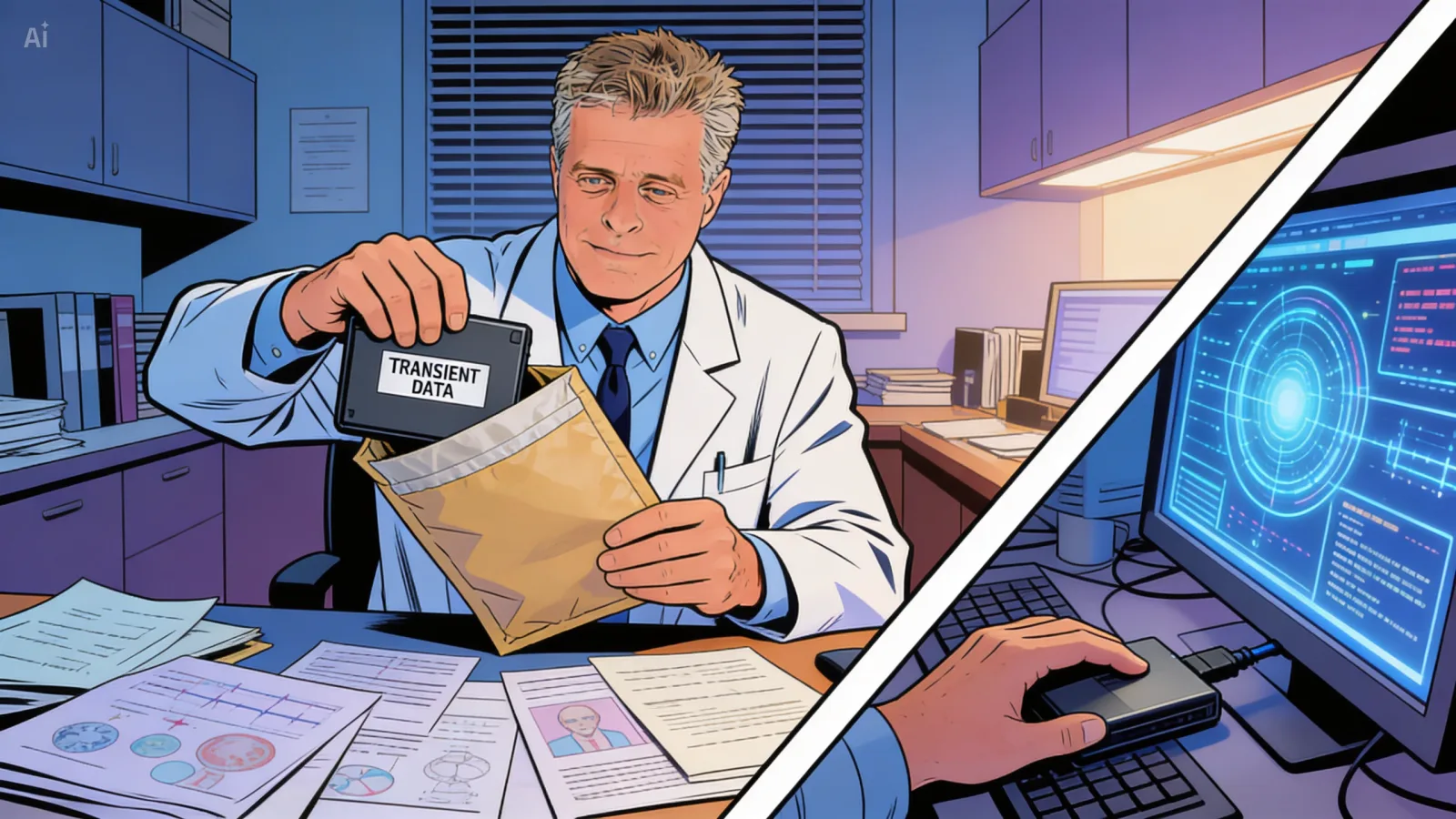
Dr. Stephen Bruehl. Clinical psychologist — expert at pulling signal from noise. He studies pain: the fuzzy, noisy human kind. Villarroel sends him a drive — 2,718 nights of transient data. She wants him to test her hunch.
HE PUTS HER HUNCH UNDER A MICROSCOPE.
HER HUNCH WAS RIGHT.
On a typical Palomar night with no nearby nuclear bomb test, transients show up on about 11% of nights.
The day after a test, that jumps to 18.5%.
Same instrument. Same plates. Same observers. The bombs are the only variable.
THE SHADOW FILTER
Then they ran it again, but this time only on the transients that had passed Villarroel's shadow test. The ones that look like real, reflective objects.
"The magnitude of the association between these flashes of light and nuclear tests was surprising — as was the very specific time at which they most often occurred: namely, the day after a test."
— Dr. Stephen Bruehl, Vanderbilt University Medical Center
ONE DATE KEPT TURNING UP.
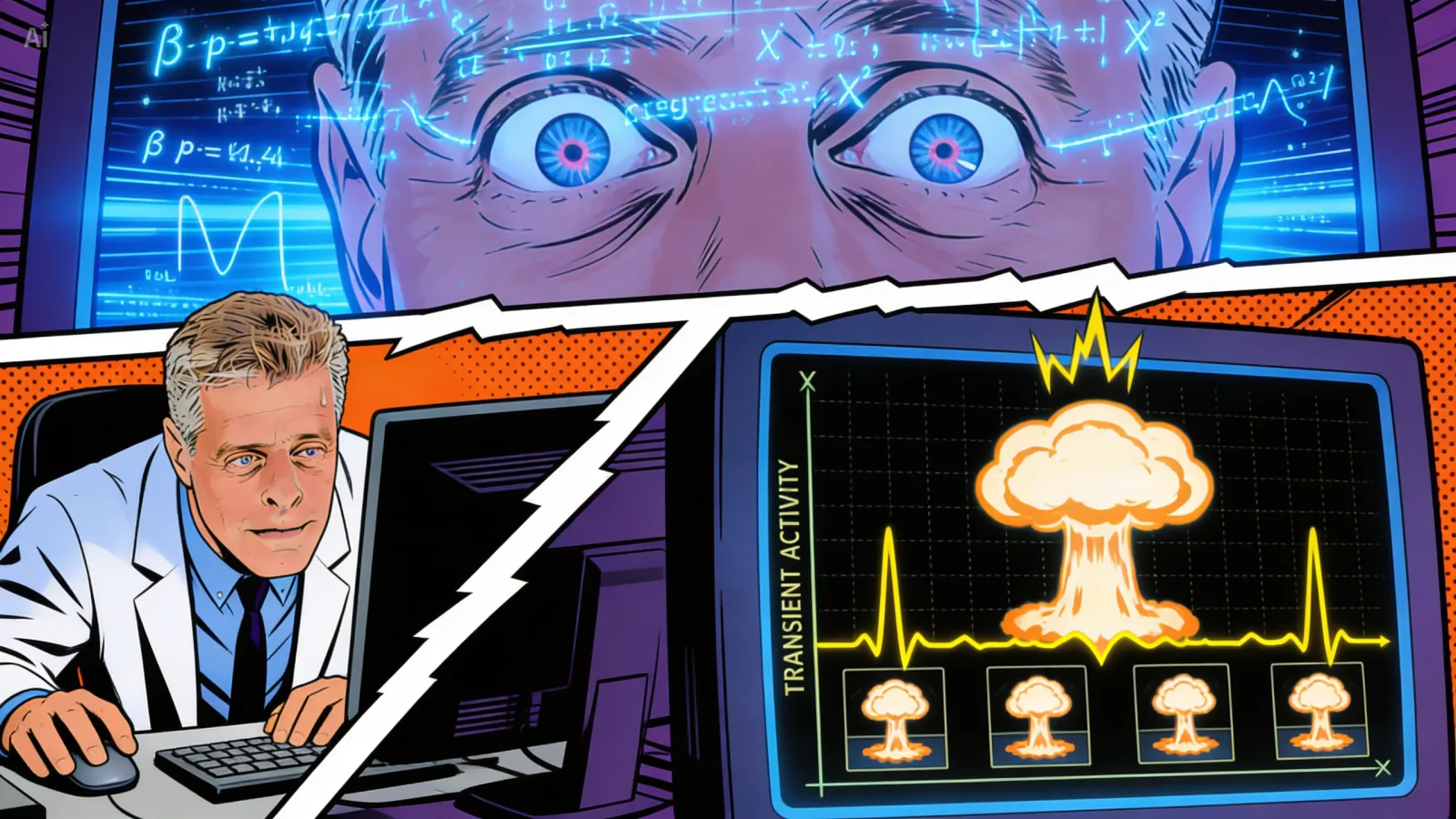
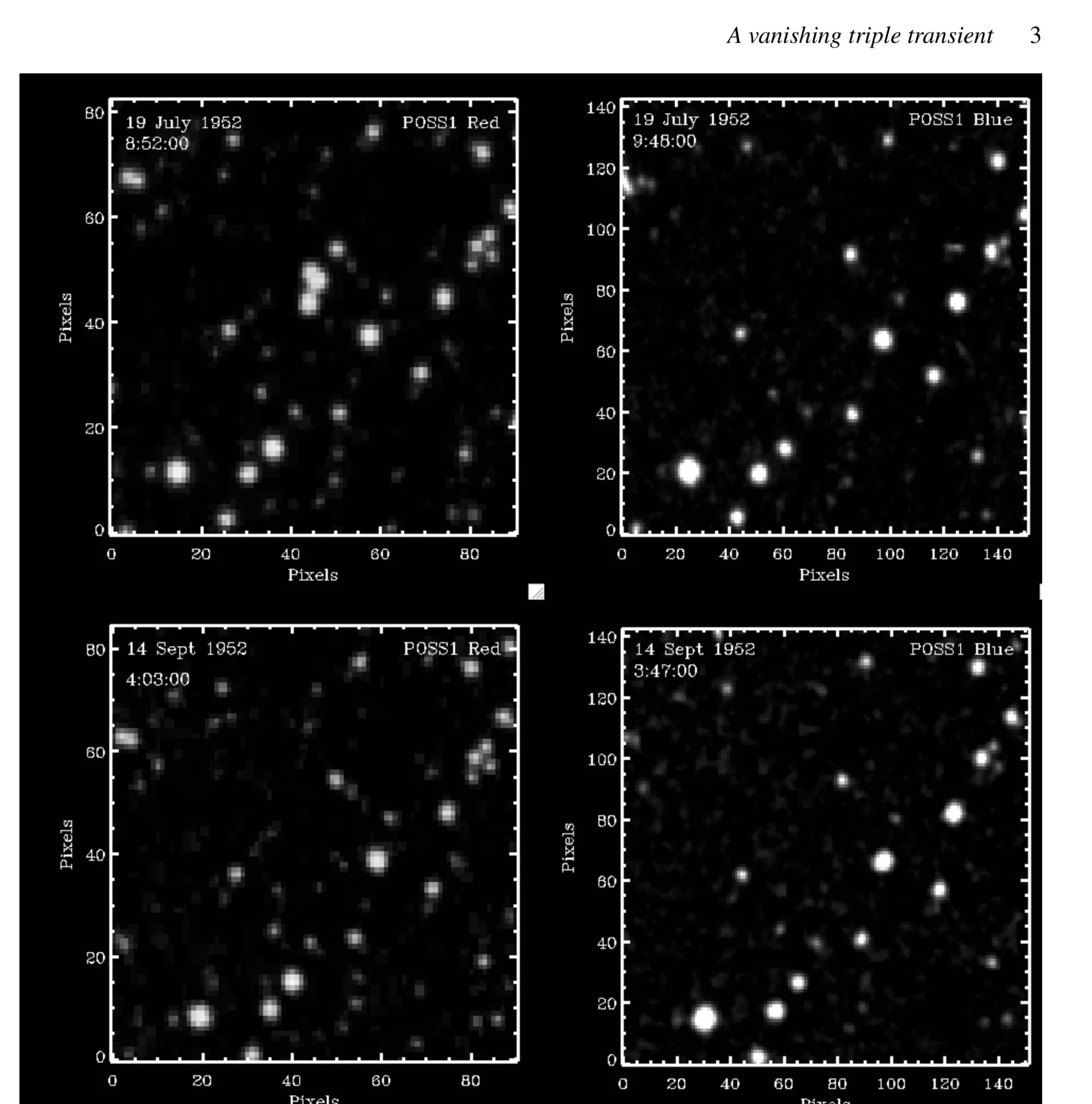
While searching the plates, Villarroel and her team kept finding transients on a particular night — including a triple flash that vanished within fifty minutes on a single plate. The plate was exposed at Palomar, 08:52 UT, July 19 1952.
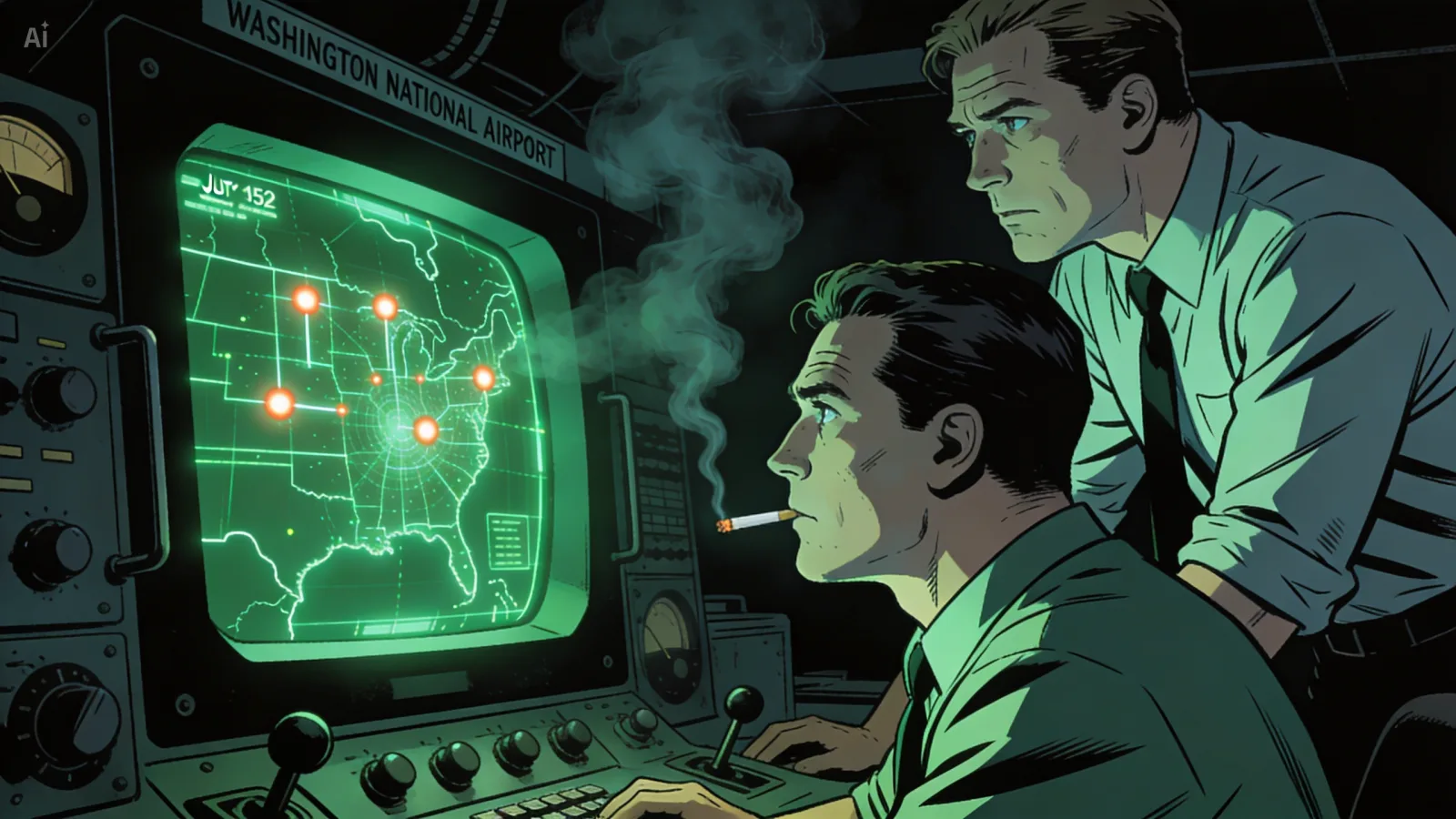
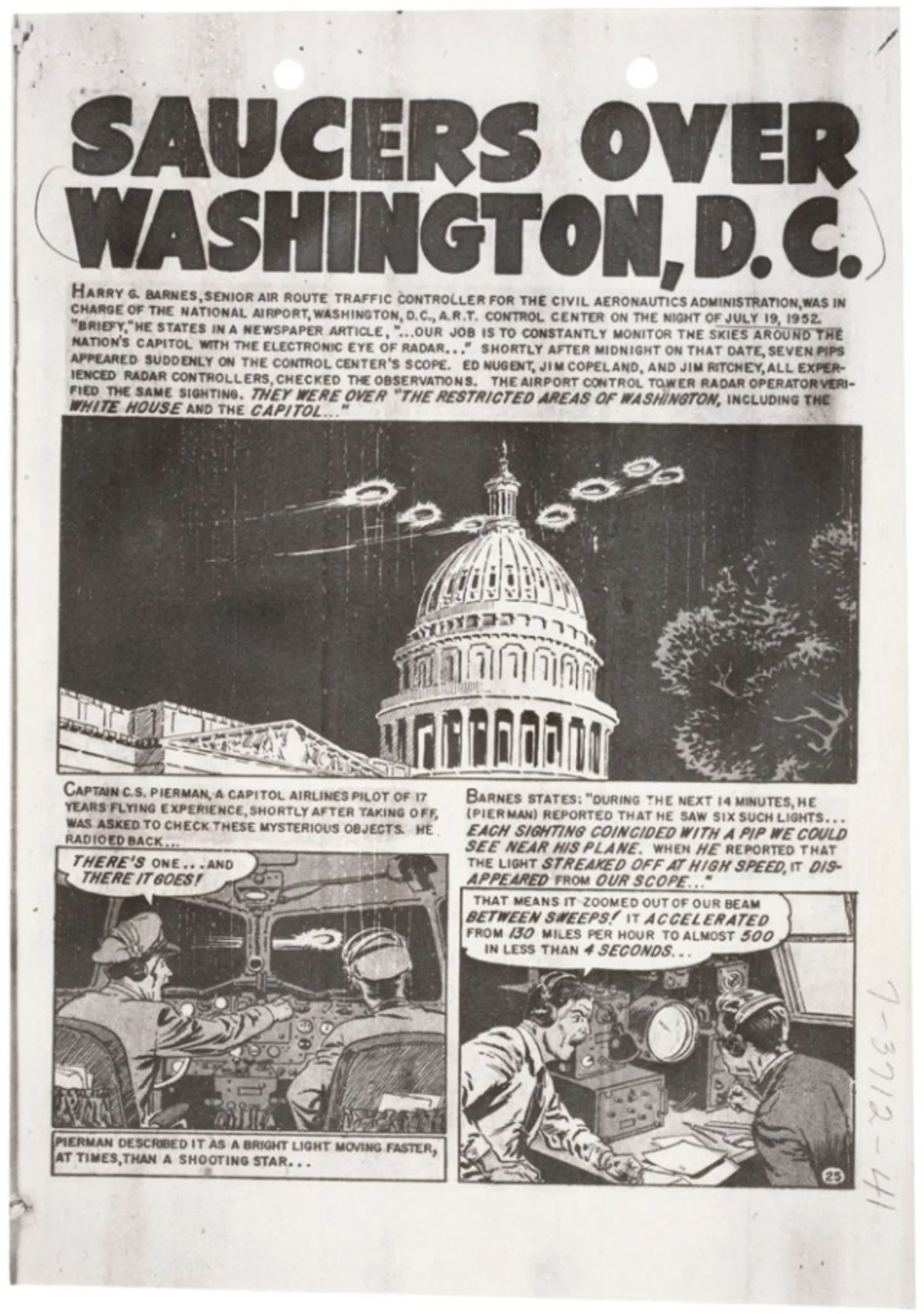
“Apparently, in 1952, during two consecutive weekends — on the 19th of July and the 27th of July — there was the most famous UFO sighting probably during the last hundred years over Washington. And it was so big that even the US Air Force had to make a special press conference.”
Barnes · National Airport
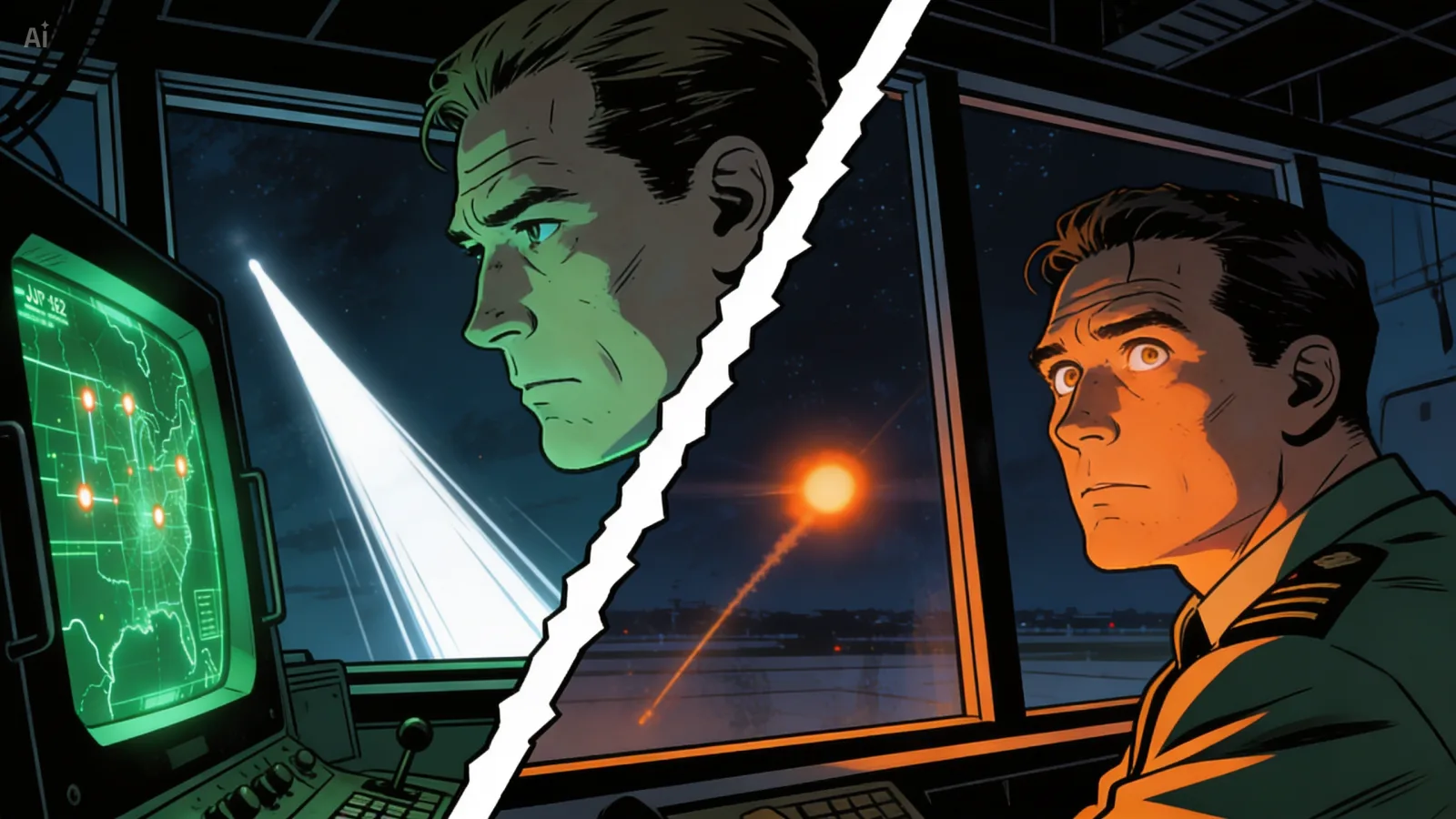
We knew immediately that a very strange situation existed… their movements were completely radical compared to those of ordinary aircraft.
Airman Brady · Andrews AFB
An object which appeared to be like an orange ball of fire, trailing a tail… unlike anything I had ever seen before.
Albert Chop · USAF Press
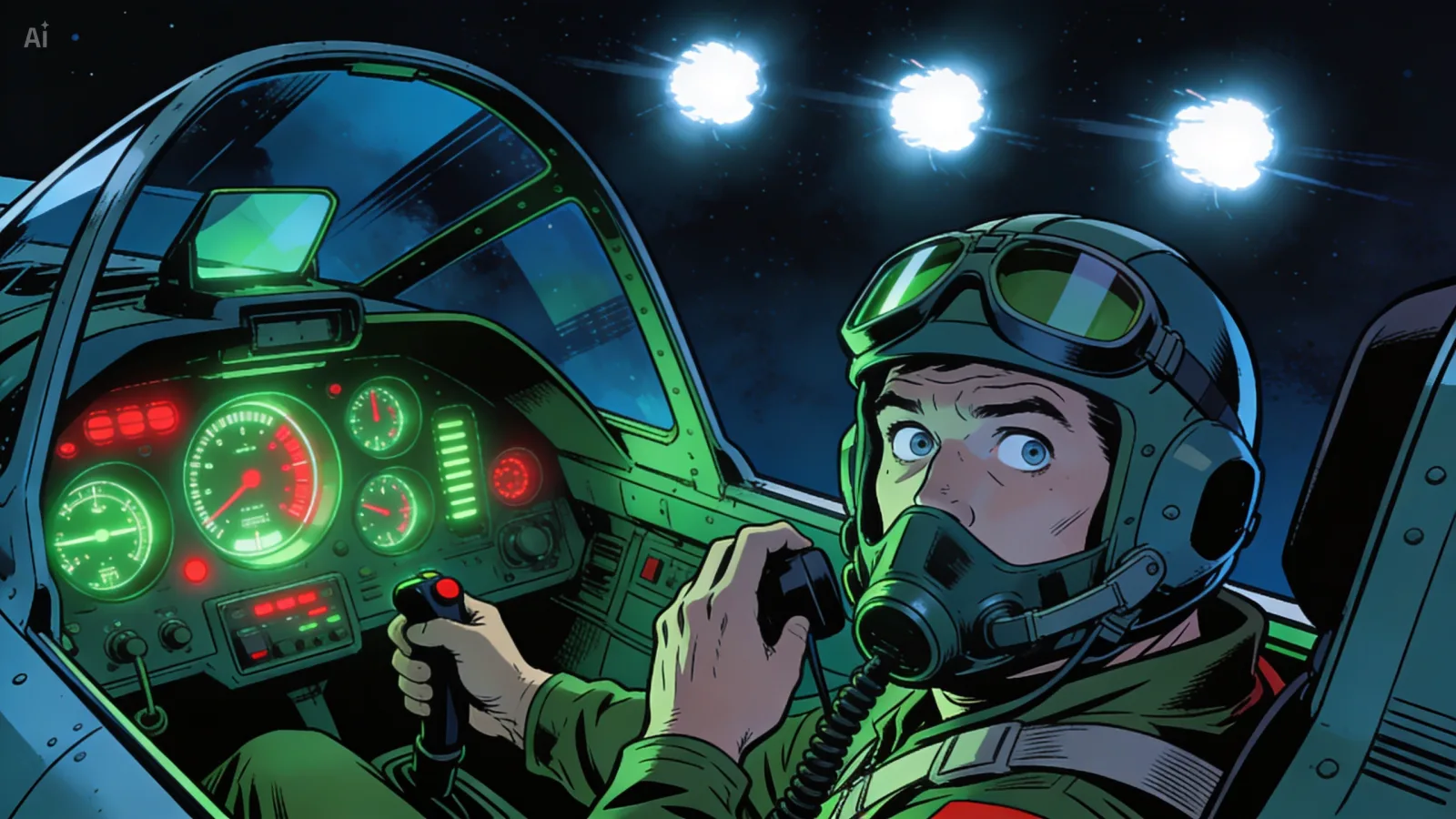
Lt. Patterson radioed for instructions when the objects surrounded his fighter. Nobody answered. Because we didn’t know what to tell him.
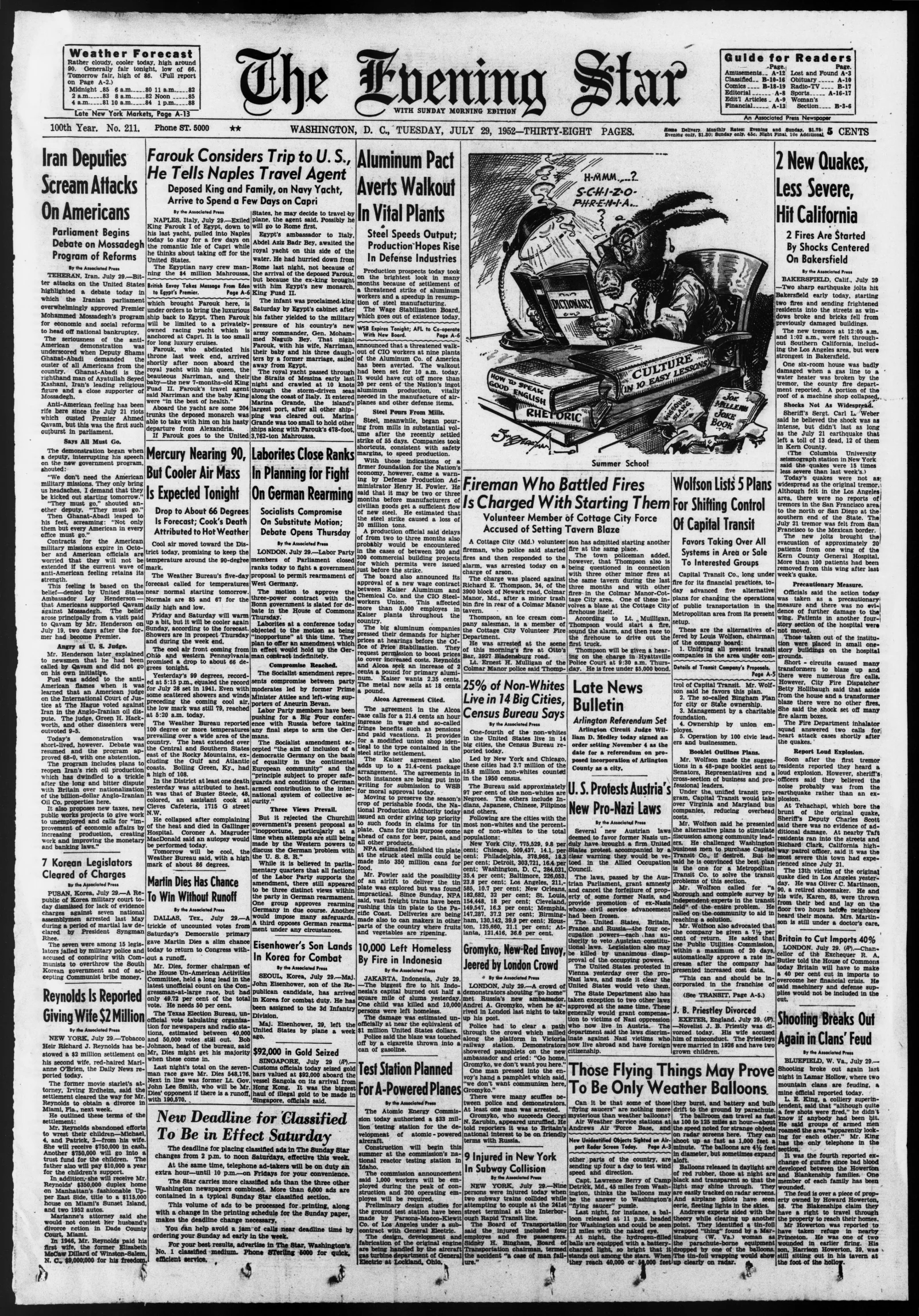
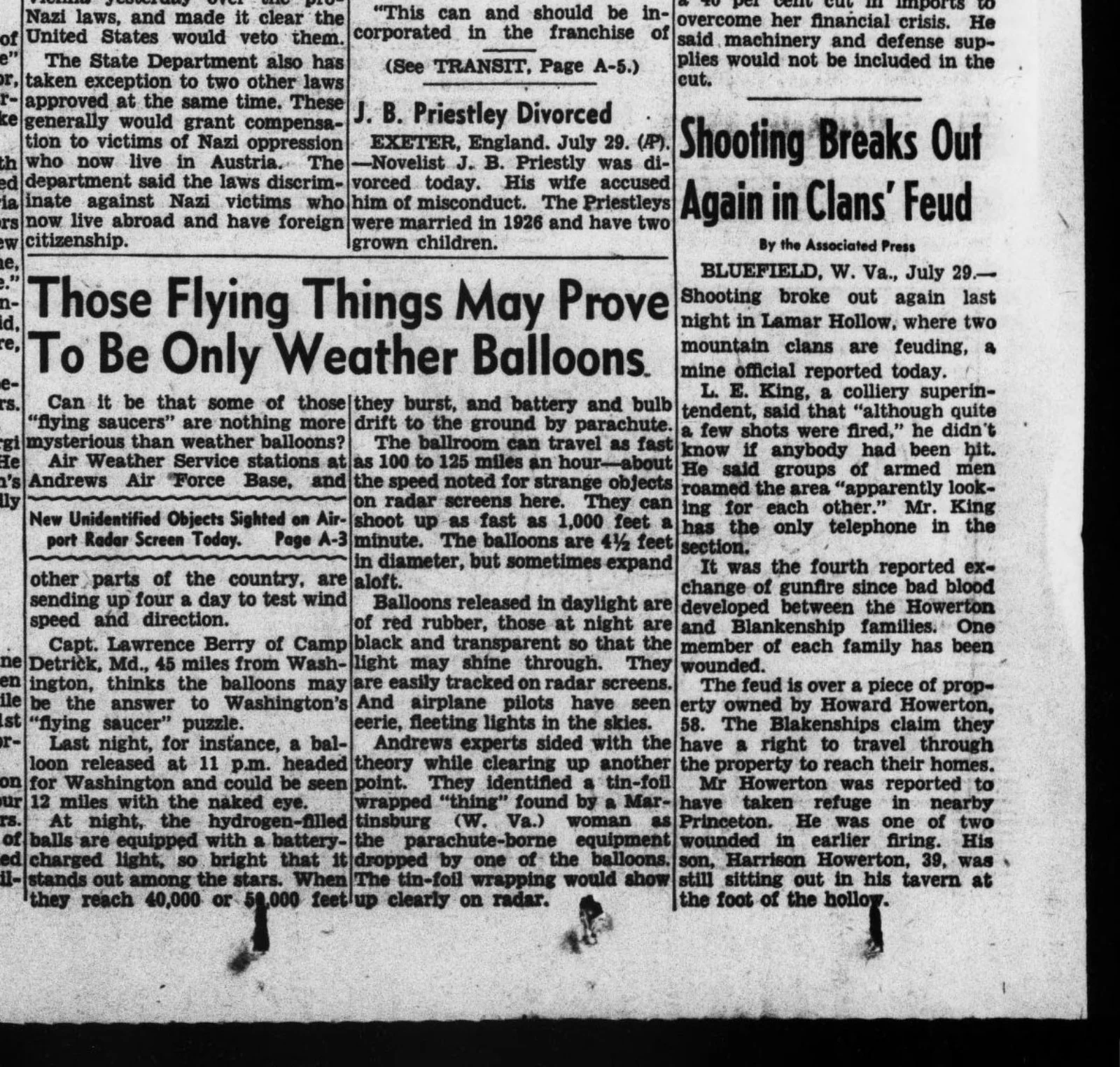
Contemporary 1952 news comic, "Saucers Over Washington, D.C."
U.S. National Archives, public domain. The Air Force did not permit photographs of the actual radar scopes that night.
Quotes via Project Blue Book / E.J. Ruppelt, The Report on Unidentified Flying Objects (1956). Wikipedia summary →
Palomar Mountain, California. The same night.
2,500 miles west. Same sky. The 48-inch Schmidt camera was running a fifty-minute red exposure. The observer had no radio to Washington. He didn't know what had just been photographed.
No one noticed. No one would — for seventy years.
THE SAME NIGHT, AT 08:52 UT.
Three pinpoints of light. One photographic plate. Vanished within fifty minutes. The Palomar archive logged them. The newspapers logged what flew over the White House later that night. Same date.
Top-left: the triple flash, just above center. Top-right: 56 minutes later. Gone. Bottom row: two months later. Still gone.
Four years on, the data tightens. The Earth-shadow holds. The nuclear-test correlation holds. In podcasts and press interviews, she starts to say what she thinks it is.
“Let's say ET sent something two hundred thousand years ago and forgot a can of Coca-Cola in space… and at some point we see these little glints.”
— Beatriz Villarroel, podcast interview, 2025.
“You don't get that kind of solar reflections from round objects… only if something is very flat and very reflective and reflects the sunlight with a short flash.”
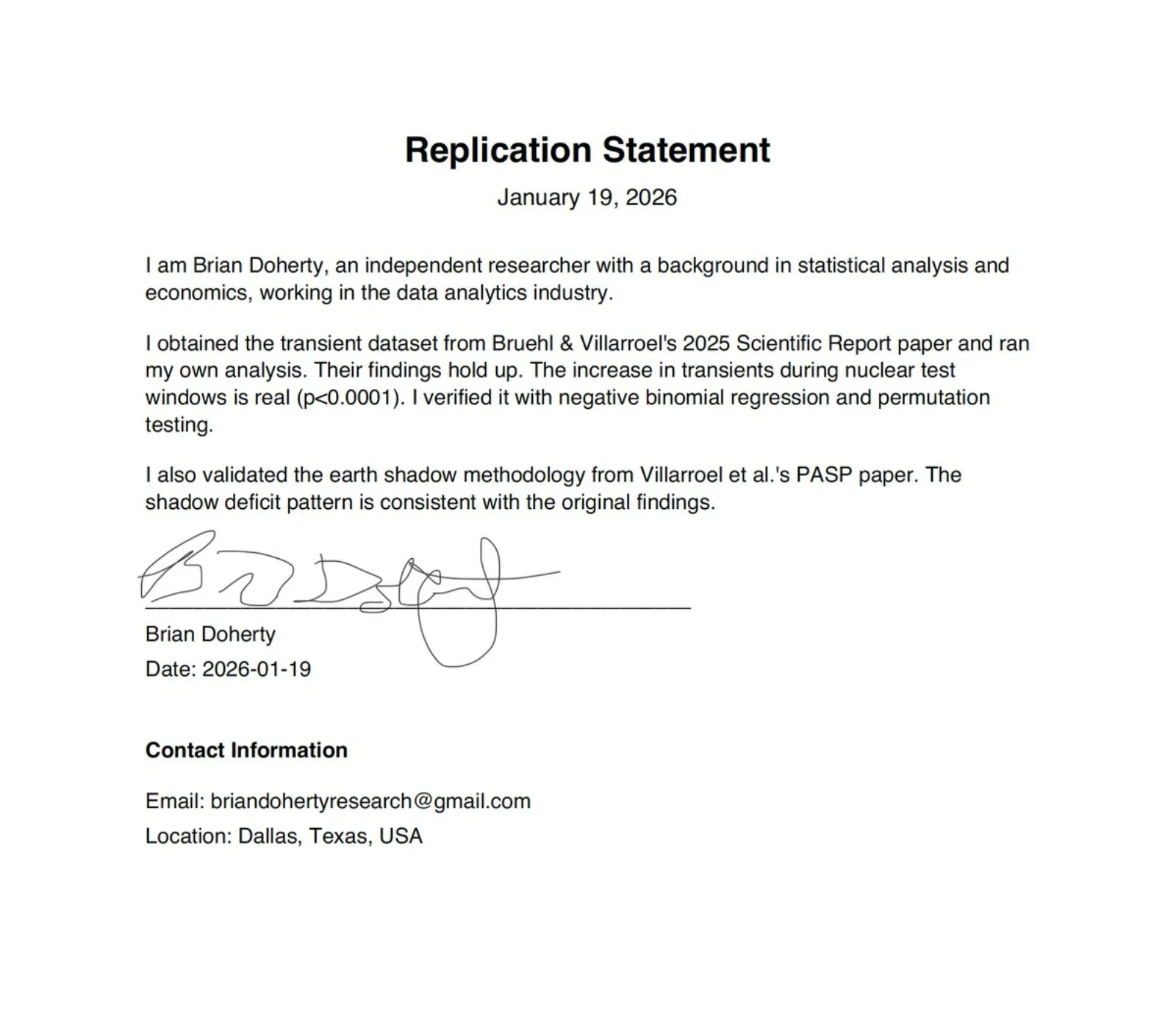
Dallas, Texas. Independent researcher. Statistical analysis · data analytics.
No university, no lab, no funding. He pulled down the dataset, wrote his own code from scratch, and ran every test independently. The findings held up — both the nuclear-test correlation and the Earth-shadow deficit.
Maybe it was only Palomar. Maybe one telescope, one mountain, one drawer of plates. Busko looked at a different archive entirely — the digitised plates from the Hamburg Observatory’s Schmidt camera, mid-1950s. He found the same narrow, star-like flashes. Different telescope. Different continent. Same signature.
Independent researcher Former US Navy reactor operator (USS South Carolina)
Cann asked a different question: what happens when Earth’s magnetic field gets battered? He cross-referenced the transient dates with the geomagnetic Kp index. The flashes drop sharply during strong magnetic storms. Then, twenty-five to forty-five days later — once the field has calmed and the plasma has refilled — they surge back to roughly three times baseline.
A camera defect can’t care about Earth’s magnetic field. But something trapped in that field can.
Cann (2026), arXiv:2604.04950 → "Geomagnetic storm suppression of photographic plate transient detections in the POSS-I archive"
Villarroel
I cannot find any other consistent explanation other than that we are looking at something artificial before Sputnik 1. For me, this looks technological. But I may be wrong.
Everything cited, plus the wider corpus this comic was built from. The science holds because the receipts hold.
Peer-reviewed papers & preprints
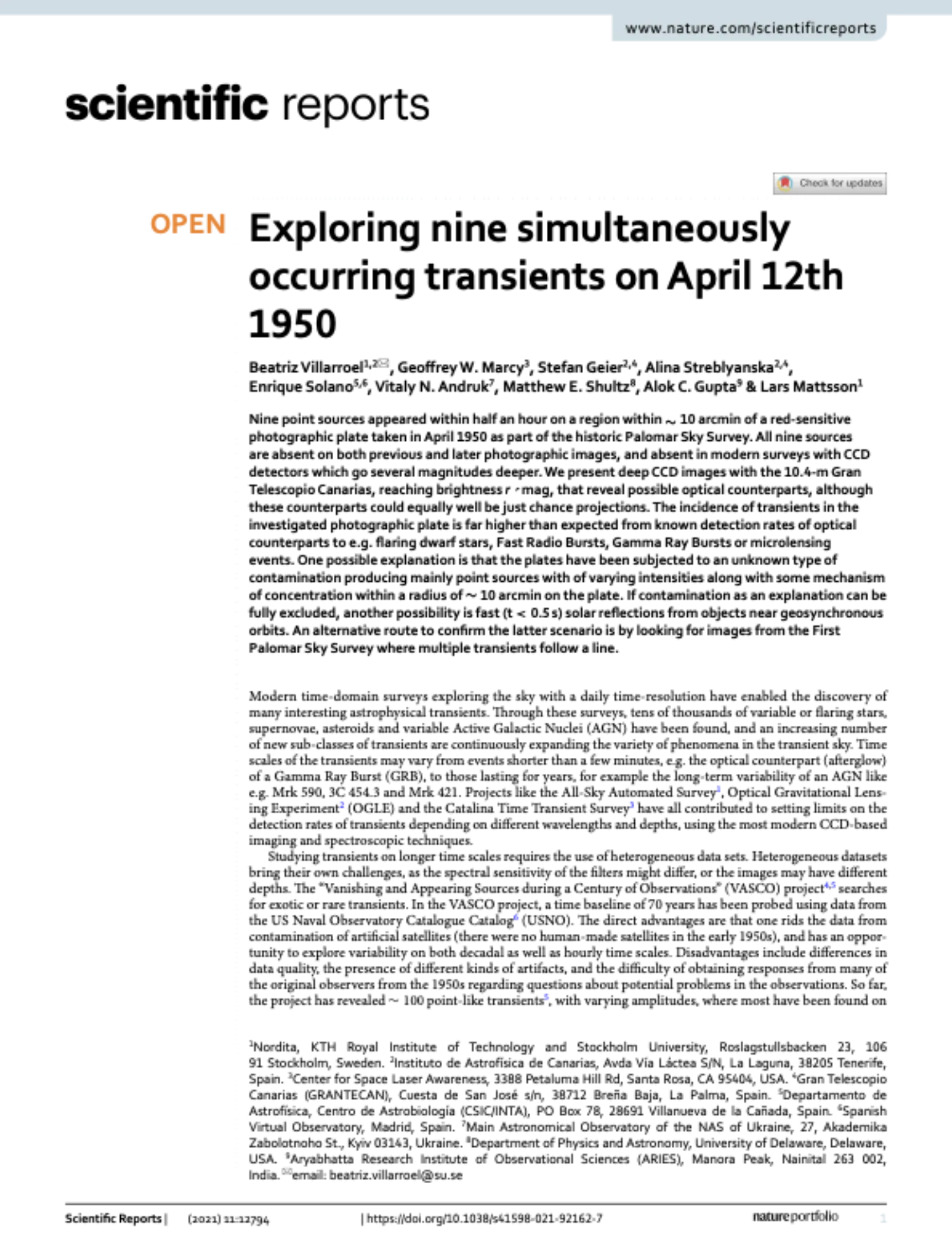
Villarroel, B. et al. (2021). "Exploring nine simultaneously occurring transients on April 12th 1950."
Nature Scientific Reports 11, 12794. nature.com
Villarroel, B. & Bruehl, S. (2025). "Aligned, Multiple-transient Events in the First Palomar Sky Survey." The Earth-shadow test.Publications of the Astronomical Society of the Pacific 137, 104504. IOP · ADS
Bruehl, S. & Villarroel, B. (2025). "Transients in the Palomar Observatory Sky Survey (POSS-I) may be associated with nuclear testing and reports of unidentified anomalous phenomena."
Nature Scientific Reports 15, 34125. nature.com
Solano, E., Villarroel, B. et al. (2024). "A bright triple transient that vanished within 50 minutes."
MNRAS 527, 6312. academic.oup.com
Hambly, N. C. & Blair, M. (2024). "On the Image Profiles of Transients in the Palomar Sky Survey." The skeptical critique.RASTI 3, 732023.
Villarroel, B. et al. (2025). Response to Hambly & Blair on POSS-I transient image profiles. The authors' reply.arXiv:2507.15896. arxiv.org
Independent replication (2026). "Independent Replication of Nuclear Test–Transient Correlations and Earth Shadow Deficit in POSS-I Photographic Plates."
arXiv:2604.00056. arxiv.org
Villarroel, B. et al. (2026). "Statistically Significant Linear Alignments Among High-Confidence Transient Candidates on POSS-I Photographic Plates."
arXiv:2605.01190. arxiv.org
"Geomagnetic storm suppression of photographic plate transients" (2026).
arXiv:2604.04950. arxiv.org
Watters, W., Dominé, L., Little, B., Pratt, K. & Knuth, K. (2026). "Critical Evaluation of Studies Alleging Evidence for Technosignatures in the POSS1-E Photographic Plates." A skeptical reanalysis arguing the shadow deficit and nuclear-test correlations do not survive proper scrutiny. Villarroel and collaborators have published a detailed response disputing the reanalysis on methodological grounds.arXiv:2601.21946. arxiv.org
Villarroel, B. et al. (2020). "The Vanishing & Appearing Sources during a Century of Observations (VASCO) project. I."
Astronomical Journal 159, 8. The VASCO methodology paper.
Monet, D. G. et al. (2003). "The USNO-B Catalog." The source list VASCO cross-matches against.Astronomical Journal 125, 984.
Hambly, N. C. et al. (2001). "The SuperCOSMOS Sky Survey — I. Introduction and description."
MNRAS 326, 1279. The high-resolution scan used for the close-up images.
Press coverage
Cooper, K. & Kim, L. (Dec 16, 2025). "The Palomar Lights: Did ET Watch Our Nuclear Tests?"
Supercluster. supercluster.com
O'Callaghan, J. (Oct 28, 2025). "Did Astronomers Photograph UFOs Orbiting Earth in the 1950s?"
Scientific American. scientificamerican.com
Anderson, P. S. (Oct 29, 2025). "Transient flashes in '50s sky plates still puzzle scientists."
EarthSky. earthsky.org
Anderson, N. (Apr 10, 2026). "Mysterious Flashes in 1950s Skies Linked to Nuclear Tests and UAP Sightings: Study."
Sci.News. sci.news
Friscourt, B. (Apr 13, 2026). "Science, Stigma, and the Search for Truth."
Sentinel News. sentinel-news.org
"'No easy explanation': Scientists are debating a 70-year-old UFO mystery as new images come to light."
Live Science. livescience.com
"It only takes one to be real and it changes humanity for ever: what if we've been lied to about UFOs?"
The Guardian (Jan 2024). theguardian.com
"Were unexplained flashes of light in 70-year-old sky surveys caused by UFOs or nuclear testing? Why not both, researchers say."
Space.com. space.com
"Mystery Of Odd Flashes Documented In Sky Before First Ever Satellite Was Launched Gets Even Odder."
IFLScience. iflscience.com
Ventura, T. "Beatriz Villarroel's UAP Research: Disappearing Stars and Nuclear-Test Correlations."
Medium / Alternative Propulsion Engineering Conference. medium.com
Vanderbilt Health News (May 7, 2026). "The truth is out there, and Stephen Bruehl is bringing the scientific method to finding it."
Vanderbilt University Medical Center. news.vumc.org
Interviews, podcasts & lectures
Villarroel, B. (2023). "Why we should search for alien artifacts."
TEDx Zurich. youtube.com
Villarroel, B. "My Personal Journey Through the Unknown: Navigating Vanishing Stars, UAPs, Stigma and Controversies in the Astronomy Community."
Penn State (Curiosity, Controversy, Courage chapter). psu.pb.unizin.org
Tim Ventura Interviews. "Are These the First Images of UAP in Orbit? With Dr. Beatriz Villarroel."
YouTube. youtube.com
"Did We Find UAP in Earth's Orbit? Beatriz Villarroel."
YouTube. youtube.com
"Breakthrough UAP Discovery in Astronomy Data with Dr. Beatriz Villarroel."
YouTube. youtube.com
American Alchemy podcast. "Top Astronomer: 'I Found 100,000 UFOs Above Earth!' (ft. Beatriz Villarroel)."
podscan.fm
Psicoactivo Podcast #534. "Dr. Beatriz Villarroel spots 100k transients around Earth from the Menzel years" (Spanish).
spotify.com
UAPedia. "Beatriz Villarroel: How Archival Astronomy Is Redefining UAP Research."
uapedia.ai
Primary sources & archives
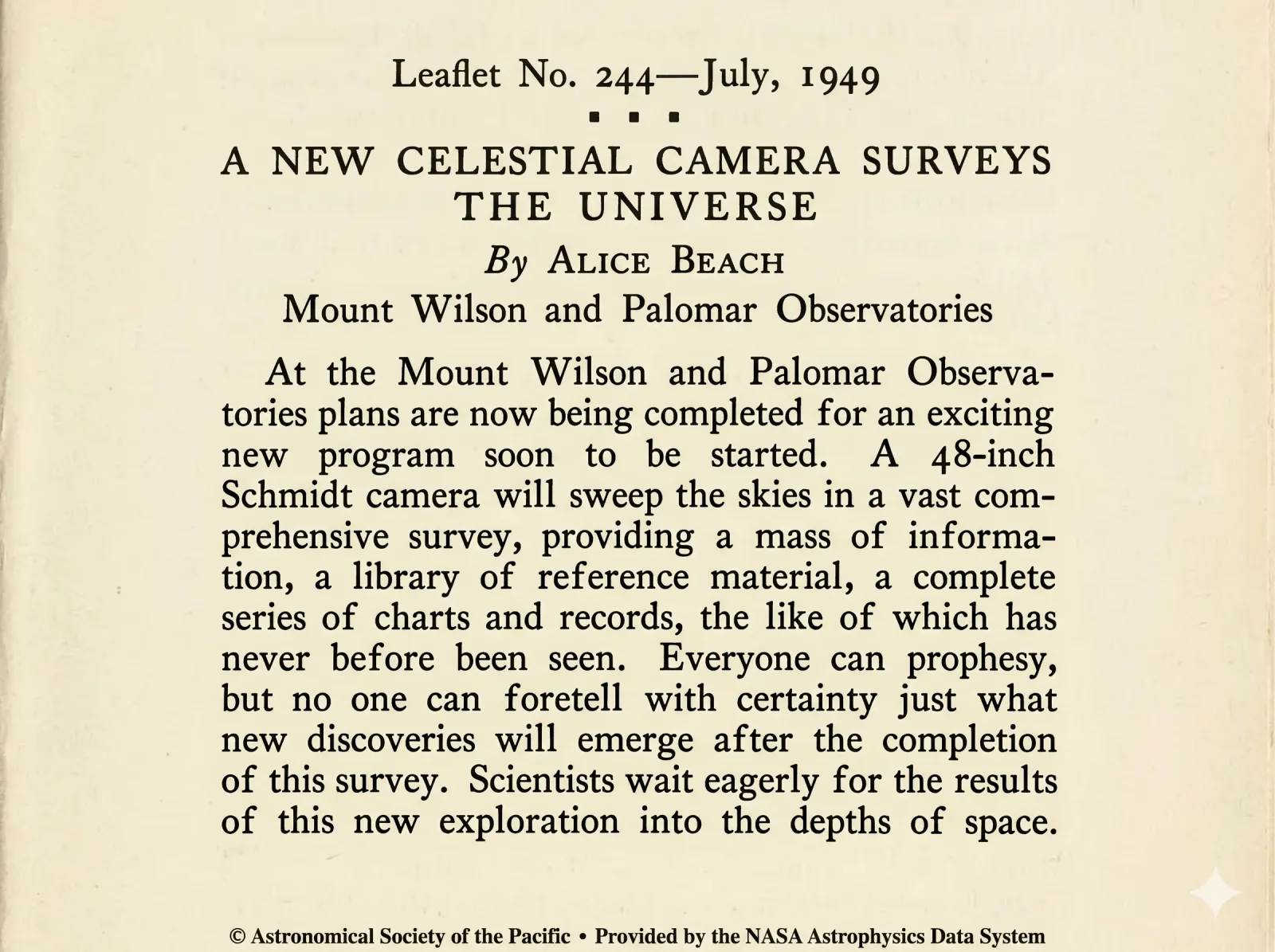
Beach, A. (Jul 1949). "A New Celestial Camera Surveys the Universe." Leaflet No. 244, Astronomical Society of the Pacific.
NASA ADS
Ruppelt, E. J. (1956). The Report on Unidentified Flying Objects. Doubleday. Source for Project Blue Book quotes (Nugent, Barnes, Brady, Patterson, Chop).
"Aligned, Multiple-transient Events in the First Palomar Sky Survey" (article).
Wikipedia. wikipedia.org
The Evening Star, Washington D.C. (Jul 29, 1952). "Those Flying Things May Prove To Be Only Weather Balloons."
Library of Congress, Chronicling America. loc.gov
"Saucers Over Washington, D.C." (1952). Contemporary news-strip comic.
U.S. National Archives. Public domain.
Samford, Maj. Gen. J. A. (Jul 29, 1952). USAF press conference, Pentagon. Largest Pentagon press briefing since World War II.
Archival film clip in the comic.
POSS-I plates: The First Palomar Observatory Sky Survey (1949–1958).Originals: Palomar Observatory, Caltech. Glass duplicates: Royal Observatory Edinburgh. Digitisations: USNO Flagstaff (PMM, used in USNO-B / DSS) and SuperCOSMOS.
APPLAUSE archive — photographic plate digitisations.
Hamburger Sternwarte. Source for the FITS plates used in this project.
Kp/Ap geomagnetic index, 1932–present.
GFZ Helmholtz Centre Potsdam.
Independent analysis & replication code
Doherty, B. (Jan 19, 2026). Independent Replication Statement — confirms the Bruehl & Villarroel (2025) nuclear-test correlation (p < 0.0001) and the Earth-shadow methodology from Villarroel & Bruehl (2025, PASP).
arXiv:2604.00056. arxiv.org
Sinkkonen, S. Bayesian hurdle negative-binomial reanalysis of the Bruehl & Villarroel transient–nuclear-test dataset.
Hierarchical models with latent random walk to control for temporal autocorrelation.
Busko, I. plateanalysis — Python notebooks for archival photographic-plate analysis (APPLAUSE-compatible).
Source of the methodology used to identify vanishing point sources.
Villarroel's public speculation — curated quotes
Coca-Cola can analogy — "Let's say ET sent something two hundred thousand years ago and forgot a can of Coca Cola in space… and at some point we see these little glints." Tim Ventura interview, 2025.
The physical specification — "very flat and very reflective and reflects the sunlight with a short flash." EarthSky, Oct 2025.
The strongest public statement — "The only hypothesis currently consistent with the full set of observations are artificial objects in high-altitude orbits prior to Sputnik." Supercluster, Dec 2025.
The Hambly comeback — "Why the 'plate defects' are avoiding the Earth's shadow?" Sentinel News, Apr 2026.
Issue №01 · The Palomar Lights
OWN THE COMPLETE INVESTIGATION
Support independent graphic science journalism. Read on your favorite tablet, or join the dispatch for upcoming issues.
Digital Edition£3
Tablet & eReader Bundle
Optional offline copy. High-resolution Tablet PDF (7.7 MB) + Comic Book Archive (.cbz for Panels & Chunky) + EPUB. The comic stays free to read online.
Based on peer-reviewed research published 2020–2026.
All quotes attributed to their original sources. The Palomar Lights — a story told in data, glass, and light.
DIGGER
A comics imprint for weird science and true stories. One issue at a time.